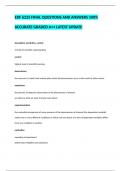
EDF 6225 FINAL QUESTIONS AND ANSWERS 100%
ACCURATE GRADED A++ LATEST UPDATE
description, prediction, control
3 levels of scientific understanding
control
highest level of scientific learning
determinism
the universe is a lawful and orderly place which all phenomenon occur as the result of other events
empiricism
the practice of objective observation of the phenomena of interest
we observe what we want to know more about
experimentation
the controlled comparison of some measure of the phenomenon of interest (the dependent variable)
under two or more different conditions in which only one factor at a time (independent variable) differs
from one condition to another
replication
repeating of experiment
determines reliability and usefulness
,parsimony
all simple explanations are ruled out before more complex or abstract explanations are considered
philosophical doubt
continuous questioning of the truthfulness and validity of all scientific theory and knowledge
applied
investigates socially significant behaviors with immediate importance to the participants
behavioral
precise movement of the actual behavior in need of improvement and documents that it was the
participant's behavior that changed
analytic
demonstrates experimental control over the occurrence and nonoccurrence of the behavior
technological
the written description of all procedures used in the study is sufficiently complete and detailed to enable
others to replicate it.
conceptually systematic
behavior change interventions are derived from basic principles of behavior
better enable research consumer to derive other similar procedures
assist in integrating discipline into a system
effective
improves behavior sufficiently to produce practical results for the participant/client.
, generality
produces behavior changes that last over time, appear in other environments, or spread to other
behaviors.
unconditioned stimulus
a stimulus will naturally respond without learning
stimulus discrimination
a procedure in which a stimulus that is similar to an established conditioned stimulus - and therefore
that elicits a conditioned response - is never followed by the unconditioned stimulus, thereby causing
the conditioned response to the stimulus estinguish
respondent
the conditioned reinforcer is elicited reflexively by a preceding stimulus
operant
the learned response (operant response) is performed because it is followed by a stimulus
positive reinforcement
added stimulus
increases frequency of response
negative reinforcement
stimulus removed
increase frequency of response
response cost
ACCURATE GRADED A++ LATEST UPDATE
description, prediction, control
3 levels of scientific understanding
control
highest level of scientific learning
determinism
the universe is a lawful and orderly place which all phenomenon occur as the result of other events
empiricism
the practice of objective observation of the phenomena of interest
we observe what we want to know more about
experimentation
the controlled comparison of some measure of the phenomenon of interest (the dependent variable)
under two or more different conditions in which only one factor at a time (independent variable) differs
from one condition to another
replication
repeating of experiment
determines reliability and usefulness
,parsimony
all simple explanations are ruled out before more complex or abstract explanations are considered
philosophical doubt
continuous questioning of the truthfulness and validity of all scientific theory and knowledge
applied
investigates socially significant behaviors with immediate importance to the participants
behavioral
precise movement of the actual behavior in need of improvement and documents that it was the
participant's behavior that changed
analytic
demonstrates experimental control over the occurrence and nonoccurrence of the behavior
technological
the written description of all procedures used in the study is sufficiently complete and detailed to enable
others to replicate it.
conceptually systematic
behavior change interventions are derived from basic principles of behavior
better enable research consumer to derive other similar procedures
assist in integrating discipline into a system
effective
improves behavior sufficiently to produce practical results for the participant/client.
, generality
produces behavior changes that last over time, appear in other environments, or spread to other
behaviors.
unconditioned stimulus
a stimulus will naturally respond without learning
stimulus discrimination
a procedure in which a stimulus that is similar to an established conditioned stimulus - and therefore
that elicits a conditioned response - is never followed by the unconditioned stimulus, thereby causing
the conditioned response to the stimulus estinguish
respondent
the conditioned reinforcer is elicited reflexively by a preceding stimulus
operant
the learned response (operant response) is performed because it is followed by a stimulus
positive reinforcement
added stimulus
increases frequency of response
negative reinforcement
stimulus removed
increase frequency of response
response cost