History of management thought 2
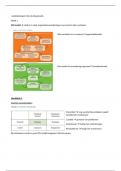
All classical management approaches share a common assumption: people at work
rationally consider opportunities made available to them and do whatever is
necessary to achieve the greatest personal and monetary gain.
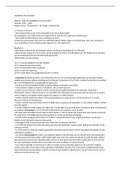
There are three types of classical approaches:
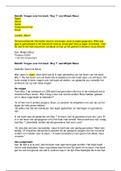
1. Scientific management
In 1911 Frederick Taylor made the statement: ‘the principal object of management
should be to secure maximum prosperity for the employer, coupled with the
maximum prosperity for the employee’. (father of scientific management)
He noticed that many workers did their jobs their own ways and without a clear and
consistent approach. He said that this caused inefficiency and low performance, this
problem could be corrected if workers were thought and then helped by supervisors
to always do their jobs in the right ways. His goal was to improve the productivity of
people at work. He used the concept of ‘time study’ to analyze the motions and tasks
required in any job and to develop the most efficient ways to perform them. To both
training for the worker and support from the supervisors (proper directions, work
assistance). Taylor’s approach includes four guiding principles/ Practical insights
from Scientific Management:
1. Develop for every job a ‘science’ that includes rules of motion, standardized
work implements, and proper work conditions
2. Carefully select workers with the right abilities for the job
3. Carefully train workers to do the job and give them proper incentives
(stimulans) to cooperate with the job science
4. Train supervisors to support workers by carefully planning their work and by
smoothing the way as they go about their jobs so they can perform to the best
of their abilities.
Motion study: is the science of reducing a task to its basic physical motions.
2. Administrative principles
1916 Henri Fayol his views on the proper management of organizations and of the
people within them. It identifies the following rules or duties of management.
1. Foresight – to complete a plan of action for the future (planning)
2. Organization – to provide and mobilize resources to implement the plan
(organizing)
3. Command – to lead, select, and evaluate workers to get the best work toward
the plan. (leading)
4. Coordination – to fit diverse efforts together and to ensure information shared
and problems solved. (leading)
5. Control – to make sure things happen according to plan and to take necessary
corrective action. (controlling)
All classical management approaches share a common assumption: people at work
rationally consider opportunities made available to them and do whatever is
necessary to achieve the greatest personal and monetary gain.
There are three types of classical approaches:
1. Scientific management
In 1911 Frederick Taylor made the statement: ‘the principal object of management
should be to secure maximum prosperity for the employer, coupled with the
maximum prosperity for the employee’. (father of scientific management)
He noticed that many workers did their jobs their own ways and without a clear and
consistent approach. He said that this caused inefficiency and low performance, this
problem could be corrected if workers were thought and then helped by supervisors
to always do their jobs in the right ways. His goal was to improve the productivity of
people at work. He used the concept of ‘time study’ to analyze the motions and tasks
required in any job and to develop the most efficient ways to perform them. To both
training for the worker and support from the supervisors (proper directions, work
assistance). Taylor’s approach includes four guiding principles/ Practical insights
from Scientific Management:
1. Develop for every job a ‘science’ that includes rules of motion, standardized
work implements, and proper work conditions
2. Carefully select workers with the right abilities for the job
3. Carefully train workers to do the job and give them proper incentives
(stimulans) to cooperate with the job science
4. Train supervisors to support workers by carefully planning their work and by
smoothing the way as they go about their jobs so they can perform to the best
of their abilities.
Motion study: is the science of reducing a task to its basic physical motions.
2. Administrative principles
1916 Henri Fayol his views on the proper management of organizations and of the
people within them. It identifies the following rules or duties of management.
1. Foresight – to complete a plan of action for the future (planning)
2. Organization – to provide and mobilize resources to implement the plan
(organizing)
3. Command – to lead, select, and evaluate workers to get the best work toward
the plan. (leading)
4. Coordination – to fit diverse efforts together and to ensure information shared
and problems solved. (leading)
5. Control – to make sure things happen according to plan and to take necessary
corrective action. (controlling)