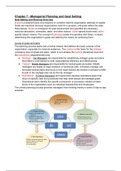
Chapter 7 - Managerial Planning and Goal Setting
Goal Setting and Planning Overview
A goal is a desired future circumstance or condition that the organization attempts to realize.
Goals are important because organizations exist for a purpose, and goals define the state
that purpose. A plan is a blueprint for goal achievement and specifies the necessary
resource allocations, schedules, tasks, and other actions. Goals specify future ends; plans
specify today’s means. The concept of planning usually incorporates both ideas; it means
determining the organization’s goals and defining the means for achieving them.
Levels of goals and plans
The planning process starts with a formal mission that defines the basic purpose of the
organization, especially for external audiences. The mission is the basis for the strategic
(company) level of goals and plans, which in turn shapes the tactical (divisional) level and
the operational (departmental) level.
● Strategic - Top Managers are responsible for establishing strategic goals and plans
that reflect a commitment to both organizational efficiency and effectiveness.
● Tactical - Middle Managers are responsible for tactical goals and plans. Middle
managers are heads of major divisions or functional units. A division manager will
formulate tactical plans that focus on the major actions the division must take to fulfill
its part in the strategic plan set by the top manager.
● Operational - Frontline Managers and supervisors develop operational plans that
focus on specific task and processes that help meet tactical and strategic goals.
Operational plans identify the specific procedures or processes needed at lower
levels of the organization such as individual departments and employees.
The overall planning process prevents managers from thinking merely in terms of day-to-day
activities.
Goal Setting and Planning Overview
A goal is a desired future circumstance or condition that the organization attempts to realize.
Goals are important because organizations exist for a purpose, and goals define the state
that purpose. A plan is a blueprint for goal achievement and specifies the necessary
resource allocations, schedules, tasks, and other actions. Goals specify future ends; plans
specify today’s means. The concept of planning usually incorporates both ideas; it means
determining the organization’s goals and defining the means for achieving them.
Levels of goals and plans
The planning process starts with a formal mission that defines the basic purpose of the
organization, especially for external audiences. The mission is the basis for the strategic
(company) level of goals and plans, which in turn shapes the tactical (divisional) level and
the operational (departmental) level.
● Strategic - Top Managers are responsible for establishing strategic goals and plans
that reflect a commitment to both organizational efficiency and effectiveness.
● Tactical - Middle Managers are responsible for tactical goals and plans. Middle
managers are heads of major divisions or functional units. A division manager will
formulate tactical plans that focus on the major actions the division must take to fulfill
its part in the strategic plan set by the top manager.
● Operational - Frontline Managers and supervisors develop operational plans that
focus on specific task and processes that help meet tactical and strategic goals.
Operational plans identify the specific procedures or processes needed at lower
levels of the organization such as individual departments and employees.
The overall planning process prevents managers from thinking merely in terms of day-to-day
activities.