Anxiety
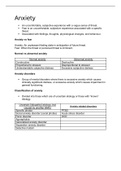
An uncomfortable, subjective experience with a vague sense of threat.
Fear is an uncomfortable, subjective experience associated with a specific
threat.
Associated with feelings, thoughts, physiological changes, and behaviour.
Anxiety vs fear
Anxiety: An unpleasant feeling state in anticipation of future threat.
Fear: When the threat or perceived threat is imminent.
Normal vs abnormal anxiety
Normal anxiety Abnormal anxiety
Constructive Destructive
Proportional to stressor Disproportional to stressor
Understandable subjective distress Excessive subjective distress
Anxiety disorders
Group of mental disorders where there is excessive anxiety which causes
clinically significant distress, or excessive anxiety which causes impairment in
general functioning.
Classification of anxiety
Divided into those which are of uncertain etiology or those with “known”
etiology.
Uncertain [Idiopathic] etiology (not
Anxiety related disorders
caused by another GMC)
Specific phobia PTSD
Social anxiety disorder (social phobia) Acute stress disorder
Panic disorder OCD
Agoraphobia
Generalized anxiety disorder
Separation anxiety disorder
Selective mutism
, Anxiety disorders due to unknown etiology
Phobias
Social anxiety disorder
General Specific Agoraphobia
(social phobia)
An excessive, persistent, An excessive, persistent, Marked fear anxiety about Marked fear or anxiety
and unreasonable fear for a and unreasonable fear for a one or more social about 2 or more of the
circumscribed stimulus, specific object, event, or situations or exposure to following:
which can be an object, situation. possible scrutiny. 1. Using public transport
event, or situation. Almost always provoke fear Fears showing anxiety 2. Being in open spaces
The stimulus almost always or anxiety. symptoms that will be 3. Being in enclosed
provokes fear or anxiety. Disproportional to the negatively evaluated. spaces
The fear or anxiety is danger posed by the phobic Almost always provokes 4. Standing in line or
disproportional to the stimulus. fear/anxiety. being in a crowd
stimulus. Persistent (6 months +) Persistent (6 months +) 5. Being outside the
The phobic stimulus is Impairs functioning or Not better accounted for by house alone
avoided or endured with cause clinically significant another mental disorder, Fears or avoids the
much anxious distress. distress. medical conditions, or situations because of
Persistent (6 months +) Not better accounted for by substances. thoughts that escape may
Impairs functioning or another mental disorder, be difficult or that help may
causes clinically significant medical condition, or not be available if panic like
distress. substances. or embarrassing symptoms
Not better accounted for by develop.
another mental disorder, Almost always provokes
medical condition, or fear/anxiety.
substances. Persistent (6 months +)
Not better accounted for by
another “”
An uncomfortable, subjective experience with a vague sense of threat.
Fear is an uncomfortable, subjective experience associated with a specific
threat.
Associated with feelings, thoughts, physiological changes, and behaviour.
Anxiety vs fear
Anxiety: An unpleasant feeling state in anticipation of future threat.
Fear: When the threat or perceived threat is imminent.
Normal vs abnormal anxiety
Normal anxiety Abnormal anxiety
Constructive Destructive
Proportional to stressor Disproportional to stressor
Understandable subjective distress Excessive subjective distress
Anxiety disorders
Group of mental disorders where there is excessive anxiety which causes
clinically significant distress, or excessive anxiety which causes impairment in
general functioning.
Classification of anxiety
Divided into those which are of uncertain etiology or those with “known”
etiology.
Uncertain [Idiopathic] etiology (not
Anxiety related disorders
caused by another GMC)
Specific phobia PTSD
Social anxiety disorder (social phobia) Acute stress disorder
Panic disorder OCD
Agoraphobia
Generalized anxiety disorder
Separation anxiety disorder
Selective mutism
, Anxiety disorders due to unknown etiology
Phobias
Social anxiety disorder
General Specific Agoraphobia
(social phobia)
An excessive, persistent, An excessive, persistent, Marked fear anxiety about Marked fear or anxiety
and unreasonable fear for a and unreasonable fear for a one or more social about 2 or more of the
circumscribed stimulus, specific object, event, or situations or exposure to following:
which can be an object, situation. possible scrutiny. 1. Using public transport
event, or situation. Almost always provoke fear Fears showing anxiety 2. Being in open spaces
The stimulus almost always or anxiety. symptoms that will be 3. Being in enclosed
provokes fear or anxiety. Disproportional to the negatively evaluated. spaces
The fear or anxiety is danger posed by the phobic Almost always provokes 4. Standing in line or
disproportional to the stimulus. fear/anxiety. being in a crowd
stimulus. Persistent (6 months +) Persistent (6 months +) 5. Being outside the
The phobic stimulus is Impairs functioning or Not better accounted for by house alone
avoided or endured with cause clinically significant another mental disorder, Fears or avoids the
much anxious distress. distress. medical conditions, or situations because of
Persistent (6 months +) Not better accounted for by substances. thoughts that escape may
Impairs functioning or another mental disorder, be difficult or that help may
causes clinically significant medical condition, or not be available if panic like
distress. substances. or embarrassing symptoms
Not better accounted for by develop.
another mental disorder, Almost always provokes
medical condition, or fear/anxiety.
substances. Persistent (6 months +)
Not better accounted for by
another “”