KRM 220 SECTION A – VICTIMOLOGY UNIT 7
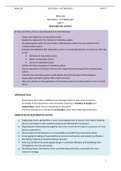
KRM 220
SECTION A - VICTIMOLOGY
UNIT 7
RESTORATIVE JUSTICE
At the end of this unit you should be able to do the following:
- Outline the objectives of restorative justice
- Explain the reasons for the interest in restorative justice
- By assessing the needs of crime victims, indicate what victims of crime need from the
criminal justice system
- Evaluate the statement that restorative justice is a reconceptualization of justice by referring
to the:
elements of restorative justice
pillars of restorative justice
values of restorative justice
- Outline the three concepts of restorative justice
- Give an exposition of the basic theories that shape the functioning of the criminal justice
system
- Indicate how restorative justice could address the shortcomings in these theories
- Assess what restorative justice offer victims of crime
- Give your opinion on the application of restorative justice on serious violent crimes in South
Africa
INTRODUCTION
- Restorative justice (RJ) is a different lens through which to view crime and justice
- According to this perspective crime should be viewed as a violation of people and
relationships, rather than just breaking the law (Zehr)
- The focus should be on putting the wrong right, rather than imposing punishment
OBJECTIVES OF RESTORATIVE JUSTICE
a. Supporting victims, giving them a voice, encouraging them to express their needs, enabling
them to participate in the resolution process and offering them assistance
b. Repairing the relationships damaged by the crime, in part by arriving at a consensus on how
best to respond to it
c. Denouncing criminal behaviour as unacceptable and reaffirming community values
d. Encouraging the taking of responsibility by all concerned parties, particularly by offenders
e. Identifying restorative, forward-looking outcomes
f. Reducing recidivism by encouraging change in individual offenders and facilitating their
reintegration into the community
g. Identifying factors that lead to crime, and informing authorities responsible for crime
reduction strategy
1
, KRM 220 SECTION A – VICTIMOLOGY UNIT 7
RESTORATIVE JUSTICE & POLICY
- The notes on click up state you can read this section on pages 116 and 117 of the textbook
WHY THIS INTEREST IN RESTORATIVE JUSTICE
- Many victims do NOT trust the CJS (e.g. time it takes to respond to calls, not wanting to
record a case, insensitive treatment, being offender centred, not apprehending the
offender, offender not being prosecuted)
- Victims often feel excluded from the process, despite the fact that they are the people most
affected by the crime
- Many argue that the state owns the case and is only concerned about what laws have been
broken and that the guilty person is appropriately punished
- Many feel that the needs of those who have suffered, whether emotional or material are
NOT a matter of concern
- It is postulated that many people realise that imprisonment is not necessarily the answer
and that retribution is not the only need of victims
- The above mentioned facts indicate the need for a radical reconceptualization of justice,
and that is the AIM of RJ
NEEDS OF CRIME VICTIMS
Summary of victim needs according to Frank:
- Access to justice and fair treatment
- Contact with CJS
- Safety (want to be safe from perpetrator and his/her family and know how to prevent
repeat victimisation)
- Give and receive information
- Assistance and services:
a. practical assistance, medical treatment, financial assistance, transport, repairs
b. emotional support
c. counselling
d. services and shelter
- The need for continuity
- To have a voice
- Validation and acknowledgement
- Restitution, redress and apology
- Answers to questions: Why me?
- Zehr developed a framework that is helpful in understanding the behaviour and emotions
after a crime
- This framework suggests that the following underlying assumptions or pillars on which we
build our sense of safety, wholeness and identity are undermined when victimisation takes
place:
1. Autonomy
2
KRM 220
SECTION A - VICTIMOLOGY
UNIT 7
RESTORATIVE JUSTICE
At the end of this unit you should be able to do the following:
- Outline the objectives of restorative justice
- Explain the reasons for the interest in restorative justice
- By assessing the needs of crime victims, indicate what victims of crime need from the
criminal justice system
- Evaluate the statement that restorative justice is a reconceptualization of justice by referring
to the:
elements of restorative justice
pillars of restorative justice
values of restorative justice
- Outline the three concepts of restorative justice
- Give an exposition of the basic theories that shape the functioning of the criminal justice
system
- Indicate how restorative justice could address the shortcomings in these theories
- Assess what restorative justice offer victims of crime
- Give your opinion on the application of restorative justice on serious violent crimes in South
Africa
INTRODUCTION
- Restorative justice (RJ) is a different lens through which to view crime and justice
- According to this perspective crime should be viewed as a violation of people and
relationships, rather than just breaking the law (Zehr)
- The focus should be on putting the wrong right, rather than imposing punishment
OBJECTIVES OF RESTORATIVE JUSTICE
a. Supporting victims, giving them a voice, encouraging them to express their needs, enabling
them to participate in the resolution process and offering them assistance
b. Repairing the relationships damaged by the crime, in part by arriving at a consensus on how
best to respond to it
c. Denouncing criminal behaviour as unacceptable and reaffirming community values
d. Encouraging the taking of responsibility by all concerned parties, particularly by offenders
e. Identifying restorative, forward-looking outcomes
f. Reducing recidivism by encouraging change in individual offenders and facilitating their
reintegration into the community
g. Identifying factors that lead to crime, and informing authorities responsible for crime
reduction strategy
1
, KRM 220 SECTION A – VICTIMOLOGY UNIT 7
RESTORATIVE JUSTICE & POLICY
- The notes on click up state you can read this section on pages 116 and 117 of the textbook
WHY THIS INTEREST IN RESTORATIVE JUSTICE
- Many victims do NOT trust the CJS (e.g. time it takes to respond to calls, not wanting to
record a case, insensitive treatment, being offender centred, not apprehending the
offender, offender not being prosecuted)
- Victims often feel excluded from the process, despite the fact that they are the people most
affected by the crime
- Many argue that the state owns the case and is only concerned about what laws have been
broken and that the guilty person is appropriately punished
- Many feel that the needs of those who have suffered, whether emotional or material are
NOT a matter of concern
- It is postulated that many people realise that imprisonment is not necessarily the answer
and that retribution is not the only need of victims
- The above mentioned facts indicate the need for a radical reconceptualization of justice,
and that is the AIM of RJ
NEEDS OF CRIME VICTIMS
Summary of victim needs according to Frank:
- Access to justice and fair treatment
- Contact with CJS
- Safety (want to be safe from perpetrator and his/her family and know how to prevent
repeat victimisation)
- Give and receive information
- Assistance and services:
a. practical assistance, medical treatment, financial assistance, transport, repairs
b. emotional support
c. counselling
d. services and shelter
- The need for continuity
- To have a voice
- Validation and acknowledgement
- Restitution, redress and apology
- Answers to questions: Why me?
- Zehr developed a framework that is helpful in understanding the behaviour and emotions
after a crime
- This framework suggests that the following underlying assumptions or pillars on which we
build our sense of safety, wholeness and identity are undermined when victimisation takes
place:
1. Autonomy
2