BUSI 3157 Business Ethics and Sustainability
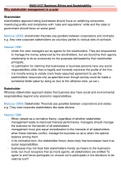
Why stakeholder management is crucial
Shareholder
shareholders approach being businesses should focus on satisfying consumers,
maximizing profits and compliance with “rules and regulations” while and the state or
government should focus on social good.
Marcoux (2003) shareholder theorists see parallels between corporations and contracts:
e.g. they view corporate stakeholders as voluntary parties to various sets of contracts
Hasnas 1998:
- Under this view managers act as agents for the stockholders. They are empowered
to manage the money advanced by the stockholders, but are bound by their agency
relationship to do so exclusively for the purposes delineated by their stockholder
principals.
- no justification for claiming that businesses or business persons have any social
responsibilities other than to legally and honestly maximize the profits of the firm.
- it is morally wrong to violate one's freely-assumed agreement to use the
stockholders' resources only as specified even though society could be made a
somewhat better place by doing so (but at the utilitarian view, ya can.)
Stakeholder
Whereas stakeholder approach states that business also have social and environmental
responsibilities beyond only economic responsibilities.
Marcoux (2003) Stakeholder Theorists see parallels between corporations and states:
e.g. They view corporate stakeholders like state citizens
Hasnas 1998:
- When viewed as a normative theory, regardless of whether stakeholder
management leads to improved financial performance, managers should manage
the business for the benefit of all stakeholders
- management must give equal consideration to the interests of all stakeholders
when these interests conflict, manage the business so as to attain the optimal
balance among them
- in its normative form, the stakeholder theory does imply that businesses have true
social responsibilities
- businesses may not treat their stakeholders merely as means to the business's
ends, but must recognize that as moral agents, all stakeholders are entitled "to
agree to and hence participate (or choose not to participate) in the decisions to be
used as such"
, - therefore, the firm's management has an obligation to "represent" the interests of all
stakeholders in the business's decision-making process
Why
Corporate citizenship & changing business environment, leading to the need of
stakeholder management
Corporations are sometimes bigger than governments so have to be responsible to a
wider group of people (employee, customer, community)
Stakeholder management: moral agents and legal agents using diff frameworks
Link to moral arguments below.
How
discussion on how through stakeholder engagement companies can also take the
‘correct’ decision
,Corporation’s Responsibilities
1. Considerations
A corporation should have moral responsibilities for its actions as:
- Legal identity
o corporations have a distinct legal identity.
- Agency
o corporations can also be said to decide and act independent of their
members (moore 1999)
o this argument is based on the idea that every organization has a
corporate internal decision structure that directs corporate decisions in
line with predetermined goals (French 1979
o result in the majority of corporate actions being regarded as the result
of corporate, not individual, decisions.
- Organisational culture
o set of beliefs and values that set out what is generally regarded as right
or wrong in the corporation—namely, the organizational culture (moore 1999
- Functional identity
o corporations present themselves and interact with customers and other
stakeholders as if they were distinct persons.
o many corporations refer to themselves as corporate ‘citizens’ and espouse
the aspiration to act as a good neighbour and partner with other members of
society
Therefore, corporations do indeed have some level of moral responsibility that is more
than the responsibility of the individuals constituting the corporation. This suggests
corporations can be moral agents as well as legal agents.
LIMITATION:
Velasquez (1983) -> corporation being moral agent is problematic
3. Corporate Social Responsibility
Hanas, 1998:
- When the phrase 'social responsibility' is used in contradistinction to this, the claim
that businesses or business persons have social responsibilities indicates that they
are obligated to expend business resources for socially beneficial purposes even
when such expenditures are not designed to help the business achieve the ends for
which it was organized.
- have ethical obligations to expend business resources in ways that do not promote
the business's fundamental purposes
Kolstad, 2007:
, - The implication of the arguments in this section is that the neo-Friedmanian
position that CSR policies should only be used to further shareholder
returns, is ethically indefensible. No reasonable ethical theory can include a
fundamental principle of profit maximization.
- Corporate social responsibility does not generally increase profitability.
- And when corporate executives only implement acts of corporate responsibility
that promote profits, and only as much of these activities as promotes profits, they
are just being profit-minded, not responsible.
- Cappelen and Kolstad (2006), One of the implications of their analysis is
that whether corporations should maximize profits or not, depends on the ability
of other institutions to fulfil other important functions. This entails that in countries
were public institutions are unable to fulfil functions normally attributed to
them, the responsibility of corporations increases, and profit maximization should
be deviated from
- The correct way of approaching the issue of corporate social responsibility, is to first
ask what a company is responsible for, and then implement these responsibilities,
whether they increase profits or not.
3a. Why do corporations have social responsibilities?
enlightened self-interest, i.e. the corporation takes on social responsibilities insofar as
doing so promotes its own self-interest. such a ‘a good business case for doing csr’, is
commonly advanced using four main arguments:
- Enhance (long-term) revenues.
o being socially responsible might be rewarded with extra and/or more
satisfied customers
o more effective workforce: employees might be more attracted to, and
committed to, corporations perceived as being socially responsible
- Reduce costs.
o helps in saving energy, reducing waste and cutting out inefficiencies
- Manage risk and uncertainty
o may forestall legislation and ensure greater corporate independence
from government
- Maintaining the social license to operate
o gaining and maintaining the consent of local communities, employees,
and governments.
Moral Arguments for CSR:
- The externalities argument
o corporations cannot escape responsibility for these impacts, whether they are
positive, negative, or neutral
o many regard corporations to have a moral responsibility to deal with, in
particular, the negative externalities they cause, such as pollution
o these are not dealt with by governments.
Why stakeholder management is crucial
Shareholder
shareholders approach being businesses should focus on satisfying consumers,
maximizing profits and compliance with “rules and regulations” while and the state or
government should focus on social good.
Marcoux (2003) shareholder theorists see parallels between corporations and contracts:
e.g. they view corporate stakeholders as voluntary parties to various sets of contracts
Hasnas 1998:
- Under this view managers act as agents for the stockholders. They are empowered
to manage the money advanced by the stockholders, but are bound by their agency
relationship to do so exclusively for the purposes delineated by their stockholder
principals.
- no justification for claiming that businesses or business persons have any social
responsibilities other than to legally and honestly maximize the profits of the firm.
- it is morally wrong to violate one's freely-assumed agreement to use the
stockholders' resources only as specified even though society could be made a
somewhat better place by doing so (but at the utilitarian view, ya can.)
Stakeholder
Whereas stakeholder approach states that business also have social and environmental
responsibilities beyond only economic responsibilities.
Marcoux (2003) Stakeholder Theorists see parallels between corporations and states:
e.g. They view corporate stakeholders like state citizens
Hasnas 1998:
- When viewed as a normative theory, regardless of whether stakeholder
management leads to improved financial performance, managers should manage
the business for the benefit of all stakeholders
- management must give equal consideration to the interests of all stakeholders
when these interests conflict, manage the business so as to attain the optimal
balance among them
- in its normative form, the stakeholder theory does imply that businesses have true
social responsibilities
- businesses may not treat their stakeholders merely as means to the business's
ends, but must recognize that as moral agents, all stakeholders are entitled "to
agree to and hence participate (or choose not to participate) in the decisions to be
used as such"
, - therefore, the firm's management has an obligation to "represent" the interests of all
stakeholders in the business's decision-making process
Why
Corporate citizenship & changing business environment, leading to the need of
stakeholder management
Corporations are sometimes bigger than governments so have to be responsible to a
wider group of people (employee, customer, community)
Stakeholder management: moral agents and legal agents using diff frameworks
Link to moral arguments below.
How
discussion on how through stakeholder engagement companies can also take the
‘correct’ decision
,Corporation’s Responsibilities
1. Considerations
A corporation should have moral responsibilities for its actions as:
- Legal identity
o corporations have a distinct legal identity.
- Agency
o corporations can also be said to decide and act independent of their
members (moore 1999)
o this argument is based on the idea that every organization has a
corporate internal decision structure that directs corporate decisions in
line with predetermined goals (French 1979
o result in the majority of corporate actions being regarded as the result
of corporate, not individual, decisions.
- Organisational culture
o set of beliefs and values that set out what is generally regarded as right
or wrong in the corporation—namely, the organizational culture (moore 1999
- Functional identity
o corporations present themselves and interact with customers and other
stakeholders as if they were distinct persons.
o many corporations refer to themselves as corporate ‘citizens’ and espouse
the aspiration to act as a good neighbour and partner with other members of
society
Therefore, corporations do indeed have some level of moral responsibility that is more
than the responsibility of the individuals constituting the corporation. This suggests
corporations can be moral agents as well as legal agents.
LIMITATION:
Velasquez (1983) -> corporation being moral agent is problematic
3. Corporate Social Responsibility
Hanas, 1998:
- When the phrase 'social responsibility' is used in contradistinction to this, the claim
that businesses or business persons have social responsibilities indicates that they
are obligated to expend business resources for socially beneficial purposes even
when such expenditures are not designed to help the business achieve the ends for
which it was organized.
- have ethical obligations to expend business resources in ways that do not promote
the business's fundamental purposes
Kolstad, 2007:
, - The implication of the arguments in this section is that the neo-Friedmanian
position that CSR policies should only be used to further shareholder
returns, is ethically indefensible. No reasonable ethical theory can include a
fundamental principle of profit maximization.
- Corporate social responsibility does not generally increase profitability.
- And when corporate executives only implement acts of corporate responsibility
that promote profits, and only as much of these activities as promotes profits, they
are just being profit-minded, not responsible.
- Cappelen and Kolstad (2006), One of the implications of their analysis is
that whether corporations should maximize profits or not, depends on the ability
of other institutions to fulfil other important functions. This entails that in countries
were public institutions are unable to fulfil functions normally attributed to
them, the responsibility of corporations increases, and profit maximization should
be deviated from
- The correct way of approaching the issue of corporate social responsibility, is to first
ask what a company is responsible for, and then implement these responsibilities,
whether they increase profits or not.
3a. Why do corporations have social responsibilities?
enlightened self-interest, i.e. the corporation takes on social responsibilities insofar as
doing so promotes its own self-interest. such a ‘a good business case for doing csr’, is
commonly advanced using four main arguments:
- Enhance (long-term) revenues.
o being socially responsible might be rewarded with extra and/or more
satisfied customers
o more effective workforce: employees might be more attracted to, and
committed to, corporations perceived as being socially responsible
- Reduce costs.
o helps in saving energy, reducing waste and cutting out inefficiencies
- Manage risk and uncertainty
o may forestall legislation and ensure greater corporate independence
from government
- Maintaining the social license to operate
o gaining and maintaining the consent of local communities, employees,
and governments.
Moral Arguments for CSR:
- The externalities argument
o corporations cannot escape responsibility for these impacts, whether they are
positive, negative, or neutral
o many regard corporations to have a moral responsibility to deal with, in
particular, the negative externalities they cause, such as pollution
o these are not dealt with by governments.