CONSUMER STUDIES
WHAT IS A CONSUMER? -
Somebody who purchases goods or services for personal use.
CONSUMER NEEDS -
Something basic somebody has to have to survive.
CONSUMER WANTS -
The desire for something that is not crucial for survival.
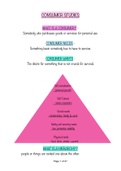
Self actualisation
- personal growth
Self Esteem
- status reputation
Social needs
- relationships, family & work
Safety and security needs
- law, protection stability
Physical needs
- food, drink, shelter, warmth
WHAT IS A HIERARCHY?
people or things are ranked one above the other.
Page 1 of 37
, CONSUMER RIGHTS
To satisfy basic needs — maslows hierarchy
Safety — health not endangered
Information — provided label etc.
Choice — options
Representation — the right to be involved
Redress — assistance
Education — wise informed decisions
Healthy environment — clean environment
CONSUMER RESPONSIBILTIES
Solidarity — work together
Critical awareness — compare prices
Social concern — purchasing affecting others
Environmental awareness — reduce, re-use, recycle
3 TYPES OF DECISION MAKING
1 - Spur of the moment , impulsive
2 - Habitual , habit
3 - Intuitive , emotional decision
CONSUMER DECISION MAKING PROCESS
Step 1 - recognise the problem
Step 2 - search for information
Step 3 - evaluate alternatives
Step 4 - make the purchase
Step 5 - post purchase behaviour
Page 2 of 37
, SUSTAINABLE CONSUMPTION DECISIONS
- Making purchasing choices that have the least possible impact on the
environment.
GOOD BUYING HABITS
Buy local
Grow your own food
Choose organic
Avoid packaging
Purposeful shopping
Shopping list
Do research
PSYCHOLOGICAL INFLUENCES
Motivation and needs
Personality
Perceptions
Values and beliefs
Attitudes and knowledge
Lifestyle
ECONOMIC INFLUENCES
Income
Credit facilities
TYPES OF SHOPPING OUTLETS
Street venders - informal
Outdoor markets - informal
Hypermarkets - formal
Page 3 of 37
, STORE CATEGORIES
CONVENIENCE STORES
Petrol service station
Common products
More expensive
SPECIALTY STORES
One of a kind products
Shopping malls
More expensive
DEPARTMENT STORES
Range of products in one store
High rent
Better quality at higher prices
Eg woolies credit facilities
HYPERMARKETS
Huge stores
Food to furniture
Large varieties
Page 4 of 37
WHAT IS A CONSUMER? -
Somebody who purchases goods or services for personal use.
CONSUMER NEEDS -
Something basic somebody has to have to survive.
CONSUMER WANTS -
The desire for something that is not crucial for survival.
Self actualisation
- personal growth
Self Esteem
- status reputation
Social needs
- relationships, family & work
Safety and security needs
- law, protection stability
Physical needs
- food, drink, shelter, warmth
WHAT IS A HIERARCHY?
people or things are ranked one above the other.
Page 1 of 37
, CONSUMER RIGHTS
To satisfy basic needs — maslows hierarchy
Safety — health not endangered
Information — provided label etc.
Choice — options
Representation — the right to be involved
Redress — assistance
Education — wise informed decisions
Healthy environment — clean environment
CONSUMER RESPONSIBILTIES
Solidarity — work together
Critical awareness — compare prices
Social concern — purchasing affecting others
Environmental awareness — reduce, re-use, recycle
3 TYPES OF DECISION MAKING
1 - Spur of the moment , impulsive
2 - Habitual , habit
3 - Intuitive , emotional decision
CONSUMER DECISION MAKING PROCESS
Step 1 - recognise the problem
Step 2 - search for information
Step 3 - evaluate alternatives
Step 4 - make the purchase
Step 5 - post purchase behaviour
Page 2 of 37
, SUSTAINABLE CONSUMPTION DECISIONS
- Making purchasing choices that have the least possible impact on the
environment.
GOOD BUYING HABITS
Buy local
Grow your own food
Choose organic
Avoid packaging
Purposeful shopping
Shopping list
Do research
PSYCHOLOGICAL INFLUENCES
Motivation and needs
Personality
Perceptions
Values and beliefs
Attitudes and knowledge
Lifestyle
ECONOMIC INFLUENCES
Income
Credit facilities
TYPES OF SHOPPING OUTLETS
Street venders - informal
Outdoor markets - informal
Hypermarkets - formal
Page 3 of 37
, STORE CATEGORIES
CONVENIENCE STORES
Petrol service station
Common products
More expensive
SPECIALTY STORES
One of a kind products
Shopping malls
More expensive
DEPARTMENT STORES
Range of products in one store
High rent
Better quality at higher prices
Eg woolies credit facilities
HYPERMARKETS
Huge stores
Food to furniture
Large varieties
Page 4 of 37