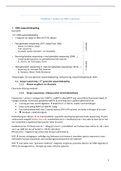
Intermolecular Forces Between
Organic Molecules
Chapter
The attractive forces btw molecules of a substance; much weaker than covalent
bonds btw atoms inside molecules; either van der Waals forces / hydrogen
bonding forces forms due 2 dipoles / induced-dipole forming on surface of
molecules.
Type of IMF
Hydrogen Bonds Dipole-Dipole London Forces
The N, O or F atom of the Haloalkanes Hydrocarbons :
one molecule alkanes, alkenes, alkynes,
cycloalkanes, cycloalkenes
H atom (which is bonded to Aldehydes Some haloalkanes e.G.
an N, O or F atom) on Tetrachloromethane,
another molecule. tetrachloroethene.
Alcohols Ketones
Carboxylic acids Esters
When the intermolecular forces btw molecules of substance = strong:
▪ Lot of energy = req overcome these IMF of attraction;
▪ Molecules aren’t easily separated from 1 another.
PHYSICAL DEFINITION PROPERTIES VS IMF
PROPERTY
Volatility Volatility = tendency of liquid 2 change Decreases if strength of
2 vapour. IMF increases.
Vapour Pressure Pressure exerted by particles of Decreases if the strength of
substance which hv vapourised (become IMF increases.
a gas), due 2 collisions w/ e/o.
Melting point Temperature @ which changes from a Increases if the strength of
solid 2 liquid. IMF increases.
Boiling point Temperature @ which changes from Increases if the strength of
liquid 2 gas & reached w/e vapour IMF increases.
pressure above liquid equals
atmospheric pressure.
Viscosity Indic of fluid's resistance 2 flow. Liq Increases if the strength of
w/ high viscosity = 'sticky’ & not flow IMF increases.
easily.
Liquid w/ low viscosity flows easily.
Organic Molecules
Chapter
The attractive forces btw molecules of a substance; much weaker than covalent
bonds btw atoms inside molecules; either van der Waals forces / hydrogen
bonding forces forms due 2 dipoles / induced-dipole forming on surface of
molecules.
Type of IMF
Hydrogen Bonds Dipole-Dipole London Forces
The N, O or F atom of the Haloalkanes Hydrocarbons :
one molecule alkanes, alkenes, alkynes,
cycloalkanes, cycloalkenes
H atom (which is bonded to Aldehydes Some haloalkanes e.G.
an N, O or F atom) on Tetrachloromethane,
another molecule. tetrachloroethene.
Alcohols Ketones
Carboxylic acids Esters
When the intermolecular forces btw molecules of substance = strong:
▪ Lot of energy = req overcome these IMF of attraction;
▪ Molecules aren’t easily separated from 1 another.
PHYSICAL DEFINITION PROPERTIES VS IMF
PROPERTY
Volatility Volatility = tendency of liquid 2 change Decreases if strength of
2 vapour. IMF increases.
Vapour Pressure Pressure exerted by particles of Decreases if the strength of
substance which hv vapourised (become IMF increases.
a gas), due 2 collisions w/ e/o.
Melting point Temperature @ which changes from a Increases if the strength of
solid 2 liquid. IMF increases.
Boiling point Temperature @ which changes from Increases if the strength of
liquid 2 gas & reached w/e vapour IMF increases.
pressure above liquid equals
atmospheric pressure.
Viscosity Indic of fluid's resistance 2 flow. Liq Increases if the strength of
w/ high viscosity = 'sticky’ & not flow IMF increases.
easily.
Liquid w/ low viscosity flows easily.