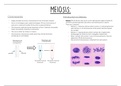
Chromosomes: Introduction to Meiosis:
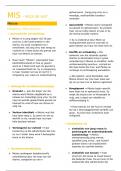
- Single-stranded structures, intertwined to form chromatin network. - Meiosis → cell division that occurs in the reproductive organs of plants &
- Occur in homologous pairs called homologues → one chromosome of animals to produce gametes (sex cells) in animals & spores in plants.
each pair is maternal (mother) & the other is paternal (father). - There are 2 divisions:
> Meiosis 1 = reduction division which results in 2 cells being formed
- Chromosomes replicate during interphase to form 2 identical chromatids
with half the no. of chromosomes of the parent cell [the haploid
(sister chromatids), joined by a centromere.
(n) number].
- This occurs either by mitosis or meiosis. > Meiosis 2 = copying division which involves the 2 haploid cells
- Chromosomes only become visible when they shorten & thicken dividing again by mitosis to form 4 daughter haploid cells.
(condense) as a cell divides. > Body / somatic cells contain 2 sets of chromosomes [ie: they are
diploid (2n) → 46 chromosomes]
Homologous pair Homologous pair > One set (23 chromosomes) is inherited from each parent.
of chromosomes of chromosomes
Replication
centromere
paternal maternal
Chromatids of paternal Chromatids of maternal
chromosome chromosome
, o
> Bivalents move to the middle of the cell & line up randomly on the equator.
> Centromeres attach to the spindle fibres.
> NB: centromeres do NOT split!
o
٭ Early Prophase
> chromosomes condense → become short, fat & visible.
> They’re visible as 2 chromatids joined by a centromere.
٭ Late prophase
> Chromosomes of homologous pairs lie alongside each other in a process called
synapsis to form bivalents.
> Centrioles move to opposite poles. o
> Spindle fibres develop across the cell between the 2 centrioles. > Bivalents separate & homologues are pulled away from each other.
> The nuclear membrane breaks down. > Chromosomes are pulled apart when spindle fibres contract → results in
random separation of maternal & paternal chromosomes.
> Crossing over occurs:
- Definition → mutual exchange of pieces of chromosome so that genes
are swapped between maternal & paternal chromosomes. o
- Occurs from late prophase → early metaphase in meiosis 1. > Invagination forms & the cytoplasm divides via cytokinesis.
- The bivalents swap pieces of their inner chromatids by breaking & > Nuclear membrane reforms & spindle fibres degenerate.
rejoining their DNA while they’re paired up. > Each chromosome is made up of 2 chromatids.
> Each new cell has one set of chromosomes (it is haploid).
Parental
chromatids
- Single-stranded structures, intertwined to form chromatin network. - Meiosis → cell division that occurs in the reproductive organs of plants &
- Occur in homologous pairs called homologues → one chromosome of animals to produce gametes (sex cells) in animals & spores in plants.
each pair is maternal (mother) & the other is paternal (father). - There are 2 divisions:
> Meiosis 1 = reduction division which results in 2 cells being formed
- Chromosomes replicate during interphase to form 2 identical chromatids
with half the no. of chromosomes of the parent cell [the haploid
(sister chromatids), joined by a centromere.
(n) number].
- This occurs either by mitosis or meiosis. > Meiosis 2 = copying division which involves the 2 haploid cells
- Chromosomes only become visible when they shorten & thicken dividing again by mitosis to form 4 daughter haploid cells.
(condense) as a cell divides. > Body / somatic cells contain 2 sets of chromosomes [ie: they are
diploid (2n) → 46 chromosomes]
Homologous pair Homologous pair > One set (23 chromosomes) is inherited from each parent.
of chromosomes of chromosomes
Replication
centromere
paternal maternal
Chromatids of paternal Chromatids of maternal
chromosome chromosome
, o
> Bivalents move to the middle of the cell & line up randomly on the equator.
> Centromeres attach to the spindle fibres.
> NB: centromeres do NOT split!
o
٭ Early Prophase
> chromosomes condense → become short, fat & visible.
> They’re visible as 2 chromatids joined by a centromere.
٭ Late prophase
> Chromosomes of homologous pairs lie alongside each other in a process called
synapsis to form bivalents.
> Centrioles move to opposite poles. o
> Spindle fibres develop across the cell between the 2 centrioles. > Bivalents separate & homologues are pulled away from each other.
> The nuclear membrane breaks down. > Chromosomes are pulled apart when spindle fibres contract → results in
random separation of maternal & paternal chromosomes.
> Crossing over occurs:
- Definition → mutual exchange of pieces of chromosome so that genes
are swapped between maternal & paternal chromosomes. o
- Occurs from late prophase → early metaphase in meiosis 1. > Invagination forms & the cytoplasm divides via cytokinesis.
- The bivalents swap pieces of their inner chromatids by breaking & > Nuclear membrane reforms & spindle fibres degenerate.
rejoining their DNA while they’re paired up. > Each chromosome is made up of 2 chromatids.
> Each new cell has one set of chromosomes (it is haploid).
Parental
chromatids