EDEXCEL CHEMISTRY PAPER 2, question and answer, verified
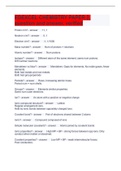
EDEXCEL CHEMISTRY PAPER 2, question and answer, verified Proton c/m? +1, 1 Neutron c/m? 0, 1 Electron c/m? -1, 1/1500 Mass number? Num of protons + neutrons Atomic number? Num protons Isotope? Different atom of the same element, same num protons. Diff number neutrons. Mendeleev vs Now? Mendeleev: Gaps for elements, No noble gases, fewer elements. Both had metals and non-metals. Both had groups/periods Periods? Rows, Increasing atomic mass. Period num = num shells. Groups? Elements similar properties. Same num outer electrons. Ion? An atom with a positive or negative charge Ionic compound structure? Lattice. Regular arrangement ions. Held by ionic bonds between oppositely charged ions. Covalent bond? Pair of electrons shared between 2 atoms Ionic? Compound composed of ions Simple molecular (covalent)? Atoms joined by covalent bonds Ionic properties? High MP + BP - strong forces between opp ions. Only conduct when molten or dissolved. Covalent properties? Low MP + BP - weak intermolecular forces. Poor conductors. Diamond? Each carbon atom, 4 strong covalent bonds = High MP. Rigid lattice structure makes diamond hard. Doesn't conduct, no free electrons. Graphite? Each atom, 3 covalent bonds = strong High MB + BP No bonds between layers, move over each other. Each atom, has one delocalised electron - conducts electricity. Fullerenes? Molecules of carbon, arranged in hexagons. Used cage other molecules, deliver drugs. Huge SA. Graphene? Fullerene. Sheet of carbon atoms joined together in hexagons. 1 sheet thick. Covalent bonds. 1 Delocalised electron to conduct electricity. Metal properties? Shiny solids. High MPs, density + good conductors. Non-metal properties? Low Bps + poor conductors. 1 dm^3? 1000cm^3 Avogadro constant? 6.02 x 10^23 Moles? Moles = Mas/RFM Which group on the periodic table is alkali metals? Group 1 Which group on the periodic table is the halogens? Group 7 Which group on the periodic table is the noble gases? Group 0 What properties do alkali metals have? Soft. Relatively low melting points. How does lithium react with water? React vigorously, bubbles produced (hydrogen). Moves around surface, fizzing. How do sodium & potassium react with water? React vigorously, bubbles produced (hydrogen). Melt in heat of reaction. Potassium ignites hydrogen gas being produced. What happens to reactivity as you go down group 1? Increases down group, outer electron lost more easily. What happens to group 1 elements when they react? Lose an electron, to form a 1+ ion. What is chlorine like at room temp? Fairly reactive Poisonous Green gas. What is bromine like at room temp? Poisonous Red-brown liquid Gives off orange vapour What is iodine like at room temp? Grey crystalline solid Gives of purple vapour when heated What happens to melting & boiling point as you go down group 7? They both increase. What is the chemical test for chlorine? Damp blue litmus paper turns red for second Then will bleach it white. How do halogens react with metals? Form salts called metal halides. 2Na + Cl2 = 2NaCl How do halogens react with hydrogen? Form hydrogen halides. H2 + Cl2 = 2HCl Why do all halogens have similar reactions? They all have the same number of electrons in their outer shell. What happens to the reactivity as you go down group 7? Need to gain 1 electron. Reactivity decreases. As larger number of shells, makes harder to attract extra electron when atomic radius larger. How do displacement reactions show reactivity trends in group 7? Chlorine displaces both bromine and iodine. Cl2 + 2KBr = Br + 2KCl. However Iodine cannot displace bromine or chlorine, as is lower down group. Why are halogen displacement reactions redox? Halogens gain electrons (reduced) & Halide ions lose electrons (oxidation). Why are the noble gases inert? They have full outer shell of electrons. What properties do noble gases have? Inert. Low flammability. Low density. Where are noble gases used? Argon in light bulbs (inert). Helium in balloons (low density + non-flammable, safer than hydrogen). Argon used to protect metals being welded (inert, stops metal reacting with oxygen). How do physical properties change down group 0? Density, melting & boiling point increase down group 0. Core practical ... Core practical ... What ways could you measure the rate of reaction? Measure the volume of gas produced. Time take for colour change to happen (universal indicator). How do reactions occur when particles collide? Reactions occur when particles collide with sufficient energy. How does increasing energy of collisions effect rate of reaction? Increases the rate of reaction, as more particles will collide with sufficient energy to react (activation energy) How does increasing the frequency of collisions effect rate of reaction? Increases the rate of reaction, higher chance of successful collision. How does temp affect rate of reaction? Increases Particles move faster = more collisions. Increases energy of collisions = more successful collisions with enough AE. How does concentration affect rate of reaction? Collisions more likely, as more particles in same volume. How does surface area affect rate of reaction? Particles have more area to work on, frequency of collisions increase. How does pressure rate of reaction? Particles more crowded, frequency of collisions increase. What is a catalyst? Substance that speeds up the rate of reaction without altering the products of the reaction, being itself chemically unchanged and in mass. How does a catalyst increase the rate of reaction? Reduces the activation energy, meaning there are more successful collisions & therefore increasing the rate of reaction. How are enzymes used in the production of alcoholic drinks? Use in fermentation process which is used to make alcoholic drinks. What is an endothermic reaction? One which takes in energy from surroundings. Shown by fall in temp of surroundings. What is an exothermic reaction? One which takes gives out energy to the surroundings. Shown by rise in temp of surroundings. What type is the breaking of bonds? Endothermic What type is the forming of bonds? Exothermic What is the activation energy? Minimum amount of energy needed for bonds to break. How does the reaction profile of an endothermic reaction look? How does the reaction profile of an exothermic reaction look? What heat changes accompany the dissolving of salts? Dissolving ammonium chloride decreases the mixture temp, so is endothermic. Dissolving calcium chloride is exothermic. What heat changes accompany neutralisation reactions? Mostly endothermic. However, reaction between ethanoic and sodium carbonate is endothermic. What heat changes accompany displacement reactions? Result in a release of energy, so = exothermic. What heat changes accompany a precipitation reaction? Exothermic. What are hydrocarbons? Compounds, contain carbon & hydrogen What is crude oil? Mixture of hydrocarbons. Containing molecules in which carbon atoms are in chains or rings. An important source of useful substances (fuels). A finite resource. How is crude oil separated through fractional distillation? Crude oil is heated, until mostly gas. Gases enter a fractionating column, which is hot at the bottom & cooler as you go up. The longer hydrocarbons, have higher BPs, turn back to liquids & drain out early on. The shorter hydrocarbons condense & drain out near the top of the column - at their BP. What are crude oil gases used for? Domestic heating & cooking What is petrol used for? Fuel for cars What s kerosene used for? Fuel for aircraft What is diesel oil used for? Fuel for some cars & trains What is fuel oil is used for? Fuel for large ships & some power stations What is bitumen used for? Surface roads & roofs What is the order of the fractions, shortest to longest hydrocarbons? Gases Petrol Kerosene Diesel Oil Fuel Oil Bitumen In which ways do hydrocarbons in different fractions differ? Number of carbon & hydrogen atoms their molecules contain. Boiling points. Viscosity. Ease of ignition. Which hydrocarbons are easier to ignite? Shorter hydrocarbons, as they have lower BPs. Which hydrocarbons haver higher BPs? Longer hydrocarbons, stronger intermolecular forces. Which hydrocarbons are more viscous? Longer hydrocarbons, thicker due to stronger intermolecular forces. What is a homologous series? Compounds that have the same general formula. Differ by CH2 in molecular formulae. Show a gradual variation in physical properties. Have similar chemical properties. What is the complete combustion of hydrocarbon fuels? A reaction in which carbon dioxide and water are produced. Energy is given out. What can the incomplete combustion of hydrocarbons produce? If there is not enough oxygen, Carbon (soot) and carbon monoxide are produced. Why is carbon monoxide dangerous? Combines with red blood cells & stops your blood being able to properly carry oxygen around your body. Lack of oxygen in blood can lead to fainting & eventually death. Why is the production of Carbon, in incomplete combustion, bad? Carbon particles deposit themselves as soot. Reduces air quality & makes buildings look dirty. What effect does impurities in hydrocarbon fuels have? Sulfur impurities in some fossil fuels, can lead to the release of sulfur dioxide (acid rain) when the fuel is burnt. What problems can acid rain cause? Causes lakes to become acidic, many plants + animals die as result. Can corrode metal. Damages stone statues. Kills trees. Why can oxides of nitrogen be produced in car engines? In the high temperatures inside the engine, nitrogen and oxygen react. What are the benefits of using hydrogen as car fuel? Very cheap. Doesn't produce carbon dioxide, or any greenhouse gases. Easily obtained. What are the disadvantages of using hydrogen as car fuel? Difficult to store. Manufacture is expensive & requires energy - often from fossil fuels. Requires a special, expensive engine. What is cracking? Breaking down larger hydrocarbons into smaller, more useful ones. Why is cracking necessary? To keep up with supply and demand. Much higher demand for shorter hydrocarbons, than there is for longer ones. How was the Earth's early atmosphere formed? Gases produced by volcanic activity. What did the Earth's early atmosphere contain? Little or no oxygen. Large amount of carbon dioxide. Water vapour. Small amounts of other gases. How were oceans formed? The water vapour in the atmosphere condensed. How did oceans affect co2 levels? Oceans decreased co2 levels, as a lot of co2 dissolved into the oceans. How did oxygen levels increase? Photosynthesis of primitive plants. What is the chemical test for oxygen? Glowing splint relights. What is the greenhouse effect? Gases in the atmosphere absorb heat radiated from the sun, releasing energy which keeps the earth warm. What evidence is there for climate change? Correlation between the change in atmospheric carbon dioxide concentration & the consumption of fossil fuels. What problems are there with data suggesting humans caused climate change? Uncertainties caused by where these measurements were taken & historical accuracy. What is the composition of today's atmosphere like? Mainly nitrogen (78%). Next largest is Oxygen (21%). Tiny amount of Argon (0.9%), Co2 (0.037%) and other gases. What are the possible effects of climate change? Rising sea levels. Extinction of species as their habitat changes. More extreme weather. Coral 'bleaching' Concentration? Concentration = mass / volume or moles/volume
Written for
- Institution
- Edexcel
- Course
- Edexcel
Document information
- Uploaded on
- March 6, 2023
- Number of pages
- 8
- Written in
- 2022/2023
- Type
- Exam (elaborations)
- Contains
- Questions & answers
Subjects
-
edexcel chemistry paper 2
-
question and answer
-
verified
-
no noble gases
-
mass number num of protons neutrons
-
mendeleev vs now mendeleev gaps for elements
-
fewer elements both had metals and non

Document also available in package deal