AQA A level Business 3.4 (Operations) Questions and Answers Rated A+
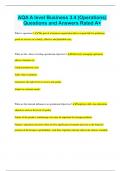
AQA A level Business 3.4 (Operations) Questions and Answers Rated A+ What is operations? The part of a business organisation that is responsible for producing goods or services in a timely, effective and profitable way. What are the values of setting operational objectives? Effectively managing operations allows a business to: Control production costs Adds value to products Guarantees the right level of service and quality Adapts to customer needs. What are the internal influences on operational objectives? Employee skill- may determine objectives such as the level of quality Nature of the product- minimising costs may be important for cheaper products Finance- operations decisions often involve significant investment and cost as the financial position of the business (profitability, cash flow, liquidity) directly affects the choices available What are the external influences on operational objectives? Legal/Political factors- eg health and safety legislation and industry regulation Economic factors- operations must be able to adapt to changing demand levels in the market Social factors- eg more customers wanting personalisation Technological factors- new product development or improving manufacturing and distribution techniques. What is labour productivity and what is its formula? This measures the output per employee and is a measure of how productive a workforce is. Labour productivity=output per time period/number of employees Give some ways in which efficiency and labour productivity can be increased. Use data to set targets and motivate the work force Use to measure the efficiency of the workforce Use as a tool for performance related pay Use as a tool for praise or reward Use to identify training needs of the workforce What is unit cost and what is its formula? Unit cost is sometimes referred to as the average cost because it takes into account the total costs of a business and divides this by the level of output Unit costs=total cost of production/number of units of output produced Uses of using unit cost data? Used to set prices on profit margin target Used to make decisions on which products to produce Used to make decisions about scale of production. What is capacity utilisation and what is its formula? Capacity utilisation is the capacity of production is the maximum amount a business can produce over a period of time given the resources it has available. Capacity utilisation=actual output in a given time period/maximum possible output in a given time period X 100 Uses of using capacity utilisation data? Setting targets for output Identifying when a business should increase capacity (growth) Identifying when a business should decrease capacity (retrenchment) Identifying the maximum level of output before production becomes ineffective (diseconomies of scale start to occur) How do you increase efficiency and productivity? Introduce new reward systems- creates incentives to work harder Better management- improves supervision and leadership of the workforce Training- improves workers skill and motivation New ways of working- design the job of the workforce to be more effective. What are the benefits of improved efficiency? Labour productivity increases Unit costs fall Profit margins increase Ability to charge lower prices and therefore improve competitiveness. What are the difficulties in increasing efficiency and labour productivity Increasing workers output may increase productivity and unit costs in the short term but high levels of output can cause burnout and stress. Moreover focusing on output may cause a compromise in quality, customer service and creativity. Also mistakes and faults are more likely to occur leading to returns and complaints. What is lean production? Lean production involves practices that reduce waste in the operational processes, whilst maintaining quality. The main forms of lean production are focused on reducing defects, time wasted and inventory levels. What is just in time production? It is where stock levels are kept to a minimum and resources and capital is freed up. It relies on effective communication and systems for order processing and delivery. It involves making products to order eg Morgan cars, then only ordering the amount of raw materials that is necessary, because of this it is important to build strong relationships with suppliers. What are the advantages and disadvantages of just in time production? Advantages= Reduced storage and security costs Less chance of stock becoming obsolete or out of date Products can be customised Disadvantages= Reduces ability to keep up with unforeseen changes in demand. Reliant on suppliers Damage to the brand if the customer needs arent met. Economies of scale opportunity lost. What is Kaizen production? It is a Japanese production method where there is continuous improvement on a consistent basis to continually improve performance. It involves regular communication with the workers so workers can contribute ideas for improvement, management to listen to workers and implement their ideas, empowerment of the workforce, What are the advantages and disadvantages of Kaizen production? Advantages= Shop and factory floor workers are often first to identify problems which can then be quickly resolved. Improves motivation Small changes are much easier to implement then large changes Disadvantages= Can be time consuming and reduce labour productivity Managers could resist change and not implement it Unsuccessful ideas may be costly. What is the optimal resource mix? It is a businesses production process that can either be labour intensive or capital intensive. The balance of the 2 depends on the nature of the product and its target market. What is the importance of capacity? Low capacity utilisation is inefficient and can increase unit costs. Similarly, reaching maximum capacity also causes problems. Businesses can use a range of techniques to control its capacity in the short term. e.g. To increase capacity you can sub contract out production to another business, offer overtime to your workers, or employ workers temporarily. To decrease capacity you can sell assets, redundancies or sub contract in work from another business. How can we use technology to improve operational efficiency? -Robots in the production process can speed up production and reduce human error -Communication systems eg zoom allow workers to communicate more effectively -Online ordering systems link in with stock management systems in logistics. What is the importance of quality? It is key in achieving customer needs. A high quality product is one that meets customer expectations. Give some methods of achieving quality. -Having a clear understanding of customer needs -Training employees in quality procedures -Invest in new and better technology -Work with quality suppliers -Achieve quality rewards What is quality control and quality assurance? Quality control is about the product and checking the quality at the end of the production process and the focus is on identifying faults Quality assurance is about the process. All the employees are involved in quality assurance with quality being considered at every step of the production process. There is also a focus on continual improvement of quality. What are the benefits and difficulties of improving quality? Benefits: Improved image and reputation, resulting in higher demand which in turn may mean greater production volumes (possibly providing better economies of scale), fewer customer complaints and returns, potentially higher selling price. Difficulties: customers perception of quality is constantly changing, improving quality may mean more work for workforce, measuring quality is difficult. What are the consequences of poor quality? If products need recalling it can become very expensive. Poor quality can damage brand reputation and image Legal costs if company gets sued Correcting poor quality can be very expensive. What are the ways and value of improving flexibility, speed of response and dependability? Flexibility- flexibility is about customisations as the greater level of customisation a business offers the better it is able to meet customer needs. Increase customisation does increase unit costs eg PC manufacturers. Speed- eg parcel delivery companies rely on speed as it can be the vital difference between competitors. Dependability- eg travel industry, dependability is vital for the travel industry as it ties in with their reputation as a company. How do you manage supply to match demand and the value of doing so? -Produce to order, so only produce product when an order comes in -Employ a flexible workforce (part-time and temporary contracts) - Outsource production to other businesses when demand is high Inventory control chart Lead time- how long it takes from the order being placed with the supplier to it arriving. Buffer inventory- the minimum amount of inventory a business wants to hold. Re-order quantities- the quantity of an item the business will order at a given time Re order level- level at which new inventory will be re ordered which will depend on the buffer stock level and the lead time. What are the influences on the choice of suppliers? -The cost and quality of materials -Dependability -Ethical practices -Availability of trade credit -Level of service -Flexibility -Speed How to manage the supply chain effectively and efficiently and the value of this? The supply chain refers to the network of providers involved in the process of getting the product to the customer. Effective management of this involves: Supplier strategy- such as long term vs short term agreements Agreeing contracts with suppliers- service level agreement or a code of conduct Deciding on what aspects of the process the business will do itself and which it will outsource. What is the value of outsourcing? Outsourcing allows the business to get more important stuff done faster, risk can be shared, reduces costs to an extent.
Written for
- Institution
- AQA A level Business 3.4
- Course
- AQA A level Business 3.4
Document information
- Uploaded on
- July 9, 2023
- Number of pages
- 11
- Written in
- 2022/2023
- Type
- Exam (elaborations)
- Contains
- Questions & answers
Subjects
-
aqa a level business 34 operations questions an

Document also available in package deal