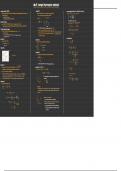
*Uses and gratification: focusing on why people use Lecture 2 Persuasive Communication Theories
Communication Lectures media and channels. Reasoning in this theory is from the
Lecture 1 Views on Communication other hand. Example: Using trip advisor for bookings Aida Model (1925)
instead of Facebook. (Awareness, Interest, Desire, Action)
1930-1950 The almighty media
*Hypodermic needle model: “You can do anything with *Dance’s helix of communication: Interpersonal Linear model, Marketers must follow all the steps to sell
communication” communication. While talking to other people, you get their product.
wiser and wiser. Communication is perceived as highly Create awareness of your product, create interest, people
Communication as a magic tool to persuade, Example: beneficial to users. must want your product and people finally must buy your
Propaganda product.
Communication can be powerful, if you get something in After 1970 The power of the media *Not always logical: People sometimes buy without
return. During the war: Follow the rules, love the leader *Agenda Setting theory: The media influencing largely awareness, interest or a real desire. Furthermore, not
or you’ll get punished. what we are talking about. What we think about a topic is always the sender starts with the buying process, mostly
therefore not affected. it is the receiver him/herself.
*Laswell’s communication model: “who (the sender) says
what (message) in which channel (medium) to whom *Framing: influencing someone’s opinion by presenting *Behavior: what people do (conscious and unconscious)
(receiver) with what effect.” information from a perspective *Belief: an idea that a person holds being true
*Attitude: how people think about something, such as “I
More critical theories, huge cap between people who are have a positive attitude towards gay marriage”
1950-1970 Limited power of the media
low or high in knowledge. *Heuristic: a quick decision rule, such as “I always buy the
*Two-step-flow-model: People are influenced by each
cheapest product”
other rather than by the mass media. *Visions on communication Van Ruler: *Norms: generally accepted by the public
The opinion of an expert, also known as opinion leader, is Information model: Transmission model, Transfer of *Values: stable long-lasting beliefs about what is
more credible and valuable than an advertisement. information, focus on how do I reach the target group + important to a person.
content of the message.
*Cognitive Dissonance: Explaining/ describing facts from Elaboration Likelihood Model
different point of views. Example: Non-Smoking campaign Persuasive model: Function to persuade and influence, Is it better to give people arguments or use emotions?
perceived by non-smokers and smokers. effect models, arrangement of messages and how do I Dependent on the level of involvement/elaboration
persuade the target group
*Osgood & Schramm’s model: No starting point, receiver *Central Route: Products of high involvement (Houses
Interactive model: exchange frames, interaction models, etc.), put a lot of time in the buying process, listen more
has a larger role in the communication process than
identify frames, understanding of other’s frames, what is to arguments – advertisements should use arguments
before.
the other’s opinion? and information to persuade – emotional appeal
Encoding and decoding principle: Convert your thoughts
to a message (encoding) Understanding of the message Relation model: Connect, coordinate models, agreement,
(decoding) *Peripheral route: low involvement (daily products),
co-ordinating with stakeholders, how do we bridge superficial (toilet paper)
interests?
1950 The power of the public
“From what are the media doing with the public to what
Theory of Planned Behaviour
Reflective model: Develop new frames, transaction
are people doing with the media” model, development of public sentiment, adjusting own
Intentional behaviour vs. behaviour
Model tries to describe or predict behaviour, whereby
and other’s frames, which public frames exist?
behaviour is influenced by our intention.
Communication Lectures media and channels. Reasoning in this theory is from the
Lecture 1 Views on Communication other hand. Example: Using trip advisor for bookings Aida Model (1925)
instead of Facebook. (Awareness, Interest, Desire, Action)
1930-1950 The almighty media
*Hypodermic needle model: “You can do anything with *Dance’s helix of communication: Interpersonal Linear model, Marketers must follow all the steps to sell
communication” communication. While talking to other people, you get their product.
wiser and wiser. Communication is perceived as highly Create awareness of your product, create interest, people
Communication as a magic tool to persuade, Example: beneficial to users. must want your product and people finally must buy your
Propaganda product.
Communication can be powerful, if you get something in After 1970 The power of the media *Not always logical: People sometimes buy without
return. During the war: Follow the rules, love the leader *Agenda Setting theory: The media influencing largely awareness, interest or a real desire. Furthermore, not
or you’ll get punished. what we are talking about. What we think about a topic is always the sender starts with the buying process, mostly
therefore not affected. it is the receiver him/herself.
*Laswell’s communication model: “who (the sender) says
what (message) in which channel (medium) to whom *Framing: influencing someone’s opinion by presenting *Behavior: what people do (conscious and unconscious)
(receiver) with what effect.” information from a perspective *Belief: an idea that a person holds being true
*Attitude: how people think about something, such as “I
More critical theories, huge cap between people who are have a positive attitude towards gay marriage”
1950-1970 Limited power of the media
low or high in knowledge. *Heuristic: a quick decision rule, such as “I always buy the
*Two-step-flow-model: People are influenced by each
cheapest product”
other rather than by the mass media. *Visions on communication Van Ruler: *Norms: generally accepted by the public
The opinion of an expert, also known as opinion leader, is Information model: Transmission model, Transfer of *Values: stable long-lasting beliefs about what is
more credible and valuable than an advertisement. information, focus on how do I reach the target group + important to a person.
content of the message.
*Cognitive Dissonance: Explaining/ describing facts from Elaboration Likelihood Model
different point of views. Example: Non-Smoking campaign Persuasive model: Function to persuade and influence, Is it better to give people arguments or use emotions?
perceived by non-smokers and smokers. effect models, arrangement of messages and how do I Dependent on the level of involvement/elaboration
persuade the target group
*Osgood & Schramm’s model: No starting point, receiver *Central Route: Products of high involvement (Houses
Interactive model: exchange frames, interaction models, etc.), put a lot of time in the buying process, listen more
has a larger role in the communication process than
identify frames, understanding of other’s frames, what is to arguments – advertisements should use arguments
before.
the other’s opinion? and information to persuade – emotional appeal
Encoding and decoding principle: Convert your thoughts
to a message (encoding) Understanding of the message Relation model: Connect, coordinate models, agreement,
(decoding) *Peripheral route: low involvement (daily products),
co-ordinating with stakeholders, how do we bridge superficial (toilet paper)
interests?
1950 The power of the public
“From what are the media doing with the public to what
Theory of Planned Behaviour
Reflective model: Develop new frames, transaction
are people doing with the media” model, development of public sentiment, adjusting own
Intentional behaviour vs. behaviour
Model tries to describe or predict behaviour, whereby
and other’s frames, which public frames exist?
behaviour is influenced by our intention.