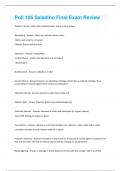
UIUC NRES 100 -Exam 2 Questions With Verified Answers
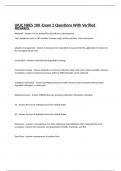
Wetlands - Answer Can be drained for agriculture or development. Text: landforms such as salt marshes, swamps, bogs, prairie potholes, and vernal pools. adaptive management - Answer is necessary for restoration to succeed.(2) the application of science to the management process. reclamation - Answer restoring land degraded by mining restoration ecology - Answer depends on science to discover what used to be, what is possible, what an ecosystem or species requires to persist, and how different goals can be achieved. ecological restoration - Answer providing assistance to the recovery of an ecosystem that has been degraded, damaged, or destroyed. Wetland services - Answer Wildlife diversity, primary production, floodwater retention. 53 - Answer Percent of wetlands lost in the United States 90 - Answer Percent of wetlands lost in the United States Kissimmee - Answer a meandering river that underwent channelization which degraded the river ecosystem, reduced the wetlands, and populations of birds, mammals, and fish. Dead Zone - Answer consequence of wetland loss Ecosystem services - Answer chemical, physical, biological, ecosystem functions provided by wetlands. Habitats for plants and animals. Principles for Restoration - Answer 1. Ecosystems are dynamic, not static 2. No simple set of rules will be applicable to a specific restoration project. 3. Adaptive management, using the best science, is necessary for restoration to succeed 4. Careful consideration of ecosystems, geology, and hydrology plays an important role in all restoration . Restoration - Answer The general criteria for judging the success of _______ 1. provides ecosystem services 2. sustainable, stable 3. integrated with landscape 4. Resilient to disturbances. Trophic cascade - Answer What is this an example of : More wolves, less elk, higher vegetation, lower stream erosion, higher stream habitat. Illinois - Answer This state had 22 million acres of prairie ( 60% of the state) and now it has 2300 acres of high quality prairie which is 0.006% of the state. Polluted Environment - Answer impure, dirty, or otherwise unclean pollution - Answer refers to the occurrence of unwanted change in the environment For example, the introduction of harmful materials and production of harmful conditions contamination - Answer implies making something unfit for a particular use through the introduction of undesirable materials. toxic - Answer materials that are poisonous to people and other living things. Toxicology - Answer the science that studies chemicals that are known to be or could be toxic. carcinogen - Answer Particular kind of toxin that increase the risk of cancer. synergism - Answer the interaction of different substances resulting in ta total effect greater than the sum of the effects of the separate substances. Point sources - Answer smokestacks, pipes discharging into waterways, stream entering the ocean, accidental spills. Non Point sources - Answer more diffused over the land which include urban and agricultural runoff, and mobile sources such as automobile exhaust. Category of Pollutants - Answer 1. infectious agents 2. Toxic Heavy Metals 3. Organic Compounds 4. Thermal Pollution 5. Particulates 6. Electromagnetic Field 7. Noise Pollution Infectious disease - Answer spread from the interactions between individuals and food, water, air, or soil. Legionellosis - Answer Pneumonia caused by bacteria in air conditioning systems Giardiasis - Answer Protozoan infection of the small intestine spread via food, water, or person to person contact. Salmonella - Answer Fodd poisoning bacterial infection spread via water or food. Malaria - Answer Protozoan infection transmitted by mosquitos. Lyme disease - Answer Bacterial disease transmitted by ticks. Cryptosporidosis - Answer Protozoan infection transmitted via water or person to person contact. Anthrax - Answer Bacterial infection spread by terrorist activity. Toxic Heavy Metals - Answer Heavy metals that pose health hazards to people and ecosystem which include mercury, lead, cadmium, nickel, gold, platinum, silver, bismuth, arsenic, selenium, vanadium, chromium, and thallium.
Written for
- Institution
- NRES 100
- Course
- NRES 100
Document information
- Uploaded on
- September 25, 2023
- Number of pages
- 16
- Written in
- 2023/2024
- Type
- Exam (elaborations)
- Contains
- Questions & answers
Subjects
-
uiuc nres 100 exam 2
-
uiuc nres 100 exam 2 questions with verified answ
-
wetlands can be drained for agriculture or develop
-
adaptive management is necessary for restoration t

Document also available in package deal