EFMB Written Test question n answers rated A+ 2023
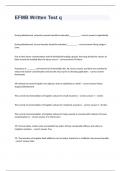
EFMB Written Test qDuring debridement, extremity wounds should be extended _________. - correct answer Longitudinally During debridement, truncal wounds should be extended _________. - correct answer Along Langer's Lines Due to their heavy contamination and the diminished healing capacity, how long should the closure of blast wounds be avoided after the injury occurs? - correct answer 48 Hours Assurance of ________ and removal of all nonviable skin, fat, fascia, muscle, and bone are essential to reduce the load of contamination and necrotic tissue prior to dressing application. - correct answer Hemostasis All methods of wound irrigation are adjuncts and not substitutes to what? - correct answer Sharp Surgical Debridement The current recommendation of irrigation volume for small wounds is: - correct answer 1 - 3 Liters The current recommendation of irrigation volume for moderate wounds is: - correct answer 4 - 8 Liters The current recommendation of irrigation volume for large wounds or wounds with evidence of heavy contamination is: - correct answer 9 or More Liters T/F: Normal saline, sterile water and potable tap water all have comparable efficacy and safety as irrigation solutions. - correct answer True T/F: The inclusion of irrigation fluid additives such as iodine, bacitracin or antibiotics has proven benefits. - correct answer False What are risk factors of invasive fungal infections assessed for during the first wound debridement? - correct answer Dismounted Blast Injury, Above the Knee Amputation, Extensive Perineal/Genitourniary/Rectal Injury, Massive transfusion of 20 units in the first 24 hours T/F: All wounds must be closed prior to arrival at a definitive care location to prevent further bacterial and fungal introduction. - correct answer False T/F: Placement of antibiotic impregnated polymethylmethacrylate (PMMA) can be used as an adjunct to debridement and irrigation of a wound to deliver increased local antibiotic concentrations while minimizing the associated side effects of high systemic loads of these antibiotics. - correct answer True A(n) _________ event refers to an iatrogenic event in which a sponge or surgical instrument is deliberately or unintentionally left behind while the wound proceeds to definitive management. - correct answer Retained Foreign Object (RFO) Explosive munitions injure through how many major mechanisms? - correct answer Four T/F: Patients exposed to hazardous noise are only at risk for aural trauma. - correct answer False The symptoms of acoustic trauma are: - correct answer Tinnitus, recruitment, aural fullness, difficulty localizing sounds, difficulty hearing in a noisy background, and vertigo. Acoustic trauma may result in sensorineural hearing loss (SNHL) that is either _____________or _____________. - correct answer Temporary (temporary threshold shift) or Permanent (permanent threshold shift). The ear, specifically the _____________, is the most sensitive organ to primary blast injury. - correct answer Tympanic Membrane (TM) T/F: The smaller the size of the tympanic membrane perforation, the greater the likelihood is of spontaneous closure. - correct answer True
Written for
- Institution
- EFMB
- Course
- EFMB
Document information
- Uploaded on
- November 3, 2023
- Number of pages
- 30
- Written in
- 2023/2024
- Type
- Exam (elaborations)
- Contains
- Questions & answers
Subjects
-
efmb written test q

Document also available in package deal