General Inorganic Chemistry Exam With 100% Correct Answers 2024
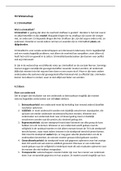
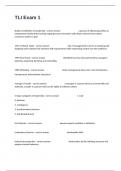
General Inorganic Chemistry Exam With 100% Correct Answers 2024 Dalton's Atomic theory - answerElements are composed of tiny indivisible particles called atoms. Inorganic Chemistry - answerstudy of the synthesis and behavior in inorganic and organometallic compounds Law of Multiple Proportions - answerIf two elements combine to form more than one compound, the ratio of the mass of an element to a fixed mass of the other element is a whole number or a simple fraction. Law of Conservation of Mass - answerMatter can neither be created nor destroyed. Law of Conservation of Energy - answerThe total quantity of energy in the universe is constant. Law of Definite Proportions - answerStates that a pure compound is made up of elements in the same proportion by mass. (Proust) Aufbau Principle - answerThe orbitals of an atom must be filled up in increasing energy levels. Pauli's Exclusion Principle - answerNo two electrons in an atom can have the same set of quantum numbers and an atomic orbital must contain a maximum of two electrons with opposite spins. Hund's Rule of Multiplicity - answerThe most stable arrangement of electrons in subshells in the one with more parallel spins. Periodic Law - answerWhen the elements are arranged in order of increasing atomic number, there is a periodic repetition of their physical and chemical properties. Valence Bond Theory - answerThe formation of a bond is due to the overlap of two atomic orbitals Molecular Orbital Theory - answerA bond is formed when electrons in the bonding molecular orbital is greater than the electrons in the non-bonding molecular orbital. Le Chatelier's Principle - answerA system in equilibrium when subjected to a stress will act in such a way to relieve the stress. Heisenberg's Uncertainty Principle - answerThe position and momentum of a particle cannot be simultaneously measured with arbitrarily high precision. Octet Rule - answerAn atom other than hydrogen tends to form bonds until it is surrounded by eight valence electrons. Molecules are more stable when the outer shells of their constituent atoms are empty, full, or have eight electrons in the outer shell. Exemption: Helium, Aluminum, Boron, Elements beyond group 3. Coulomb's Law - answerThe potential energy between two ions is directly proportional to the product of their charges and inversely proportional to the distance between them. Graham's Law of Diffusion - answerUnder the same conditions of temperature and pressure, rates of diffusion for gases are inversely proportional to the square roots of their molar masses. Hess's Law - answerWhen Reactants are converted to products, the change in enthalpy is the same whether the reaction takes place in one step or in a series of steps. Slater's Rule - answerA more accurate representation of the shielding effect. VSEPR Theory - answerValence Shell Electron Pair Repulsion; arrangement such that atoms are kept as far away from each other to minimize repulsion (e-pair) Atomic number - answerThe number of protons in the nucleus of an atom Mass number - answerTotal nu
Written for
- Institution
- Inorganic chemistry
- Course
- Inorganic chemistry
Document information
- Uploaded on
- February 16, 2024
- Number of pages
- 9
- Written in
- 2023/2024
- Type
- Exam (elaborations)
- Contains
- Questions & answers
Subjects
-
general inorganic chemistry exam with 100 correct

Document also available in package deal