WGU Business Acumen C201 - ch15 Questions and Answers
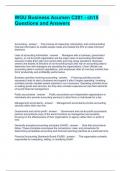
WGU Business Acumen C201 - ch15 Questions and Answers Accounting The process of measuring, interpreting, and communicating financial information to enable people inside and outside the firm to make informed decisions. Uses of accounting information Managers with a business, government agency, or not-for-profit organization are the major users of accounting information, because it helps them plan and control daily and long-range operations. Business owners and boards of directors of not-for-profit groups also rely on accounting data to determine how well managers are operating the organizations. Union officials use accounting data in contract negotiations, and employees refer to it as they monitor their firms' productivity and profitability performance. Brainpower Read More Previous Play Next Rewind 10 seconds Move forward 10 seconds Unmute 0:00 / 0:15 Full screen Business activities involving accounting Financing activities provide necessary funds to start a business and expand it after it begins operating. Investing activities provide valuable assets required to run a business. Operating activities focus on selling goods and services, but they also consider expenses as important elements of sound financial management. Public accountants Public accountants are independent organizations or individuals who provide accounting services to other firms or individuals for a fee. Management accountants Management accountants provide accounting services within their own firm. Government and not-for-profit Government and not-for-profit accountants perform accountants many of the same functions as management accountants, focusing on the effectiveness of their organization or agency rather than on profit or loss. Generally accepted accounting principles (GAAP) Rule that accountants follow. These principles encompass the conventions, rules, and procedures for determining acceptable accounting and financial reporting practices at a particular time. Financial Accounting Standards Board (FASB) The organization primarily responsible for evaluating, setting, or modifying GAAP. Foreign Corrupt Practices Act A federal law that prohibits U.S. citizens and companies from bribing foreign officials in order to win or continue business. The accounting cycle The procedure by which accountants convert data about individual transactions to financial statements. Asset Anything of value owned or leased by a business. Liability Anything owed to creditors—that is, the claims of a firm's creditors. Owners' equity The owners' initial investment in the business plus profits that were not paid out to owners over time in the form of cash dividends. The accounting equation Assets must equal liabilities plus owners' equity. This equation reflects the financial position of a firm at any point in time. Double-entry bookkeeping The process by which accounting transactions are recorded. The impact of computers and the Internet on the accounting process Computers have streamlined the accounting process, making it both faster and easier. Several software producers offer Web-based accounting products designed for small and medium-sized businesses. Among other benefits, these products allow users to access their complete accounting systems from anywhere using a standard Web browser. Balance sheet Accounting statement that shows the financial position of a company as of a particular date and makes explicit the basic accounting equation (Assets = Liabilities + Owners' Equity). Income statement Accounting statement that shows the income, expenses, and profits or losses of a company during a period of time. Statement of cash flows Accounting statement that provides investors and creditors with information about a company's cash receipts and payments during an accounting period. Ratio analysis One of the most commonly used tools for measuring a firm's liquidity, profitability, and reliance on debt financing, as well as the effectiveness of management's resource utilization. This analysis also allows comparisons with other firms and with the firm's own past performance. Liquidity ratios Measure a firm's ability to meet its short-term obligations. Two commonly used liquidity ratios are the current ratio and the acid-test ratio. Activity ratios Measure the effectiveness of management's use of the firm's resources. How fast inventory is moving or how much sales are generated from each dollar invested in assets can be measured using activity ratios. Profitability ratios Measures the organization's overall financial performance by evaluating its ability to generate revenues in excess of operating costs and other expenses.
Written for
- Institution
- WGU C201
- Course
- WGU C201
Document information
- Uploaded on
- April 9, 2024
- Number of pages
- 3
- Written in
- 2023/2024
- Type
- Exam (elaborations)
- Contains
- Questions & answers
Subjects
-
wgu business acumen c201 ch15 questions and answ
-
accounting the process of measuring interpreting
-
uses of accounting information managers with a bus
-
public accountants public accountants are indepen

Document also available in package deal