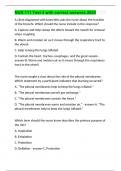
NUR 111 Test 4 with correct answers 2024
A client diagnosed with bronchitis asks the nurse about the function of the bronchi. Which should the nurse include in the response? A. Capture and help sweep the debris toward the mouth for removal when coughing B. Warm and moisten air as it moves through the respiratory tract to the alveoli C. Help to keep the lungs inflated D. Contain the heart, trachea, esophagus, and the great vessels - answer-B. Warm and moisten air as it moves through the respiratory tract to the alveoli The nurse taught a class about the role of the pleural membranes. Which statement by a participant indicates that learning occurred? A. "The pleural membranes help to keep the lungs inflated." B. "The pleural membranes permit gas exchange." C. "The pleural membranes contain the heart." D. "The pleural membranes warm and moisten air." - answer-A. "The pleural membranes help to keep the lungs inflated." Which term should the nurse know describes the primary purpose of the ribs? A. Inspiration B. Exhalation C. Protection D. Deflation - answer-C. Protection The nurse is assessing an 8-year-old client. Which anatomical difference should the nurse expect to find compared to an adult? (Select all that apply.) A. Smaller nasopharynx B. Soft tracheal cartilage C. Larynx and glottis lower in the neck D. Atrophy of the tonsils E. Small mouth with large tongue - answer-A. Smaller nasopharynx B. Soft tracheal cartilage E. Small mouth with large tongue The nurse is participating in a community health clinic. Which client should the nurse identify as being at risk for compromised oxygenation? (Select all that apply.) A. A 70-year-old woman who eats a well-balanced diet and exercises daily B. A 28-year-old man who smokes with a 10 pack per year history C. A 46-year-old woman with a history of anxiety attacks D. A 64-year-old woman with osteoporosis and limited mobility E. A 56-year-old man who has been working at a textile factory - answer-B. A 28-year-old man who smokes with a 10 pack per year history C. A 46-year-old woman with a history of anxiety attacks D. A 64-year-old woman with osteoporosis and limited mobility E. A 56-year-old man who has been working at a textile factory The nurse is performing a respiratory assessment on a young adult. Which finding is considered an alteration of oxygenation? (Select all that apply.) A. Tachypnea B. Eupnea C. Dyspnea D. Orthopnea E. Retractions - answer-A. Tachypnea C. Dyspnea D. Orthopnea E. Retractions Which method is the most accurate for measuring a client's respiratory rate? A. Measure the respiratory rate for 15 seconds and multiply by 4. B. Measure the respiratory rate for 30 seconds and multiply by 2. C. Measure the respiratory rate for 6 seconds and multiply by 10. D. Measure the respiratory rate for 1 minute. - answer-D. Measure the respiratory rate for 1 minute. The nurse assessing a newborn suspects respiratory distress. Which finding supports the suspicion? A. Intercostal retractions B. Respiratory rate of 44 C. Acrocyanosis at birth D. Abdominal breathing - answer-A. Intercostal retractions Which manifestation should the nurse recognize as a sign of chronic respiratory disease in a client? A. Inspiration to expiration (I:E) ratio of 1:2 B. Crackles noted in bilateral lungs C. Sudden shortness of breath D. Clubbing of the nails - answer-D. Clubbing of the nails The nurse assessing a client suspects a right pneumothorax. Which finding supports the nurse's suspicion? A. Right tracheal shift B. Asymmetry of the chest expansion C.O2 saturation of 94% D. Decreased expansion on the left side of the chest - answer-B. Asymmetry of the chest expansion The nurse is planning care for a client who is receiving oxygen. Which intervention should the nurse include? A. Assess the client for anxiety. B. Suction upper airways each shift. C. Ensure the client is comfortable with the manner of administration. D. Increase the oxygen flow if the client requests. - answer-C. Ensure the client is comfortable with the manner of administration. The nurse is caring for a client with a chest tube. Which intervention should the nurse implement? (Select all that apply.) A. Assess for pain. B. Prescribe pain medications as needed. C. Report hyperresonance with percussion. D. Monitor for air leaks. E. Ensure oxygen is available. - answer-A. Assess for pain. D. Monitor for air leaks. E. Ensure oxygen is available. The nurse is caring for a client with an alteration in oxygenation. Which independent action should the nurse perform? (Select all that apply.) A. Prescribe oxygen therapy. B. Teach about smoking cessation. C. Place the client in high Fowler position. D. Suction the upper airway. E. Order a diet high in iron. - answer-B. Teach about smoking cessation. C. Place the client in high Fowler position. D. Suction the upper airway. A client has crackles and reports increasing shortness of breath. Which action should the nurse take first? A. Place the client in high Fowler position. B. Administer a bronchodilator. C. Assess the respiratory rate. D. Apply oxygen to the client. - answer-A. Place the client in high Fowler position. The nurse preceptor is monitoring the actions of a new graduate nurse caring for a client with a tracheostomy. Which action by the new graduate requires follow-up from the preceptor? A. Assessing for irritation around the stoma B. Suctioning the tracheostomy, then the mouth C. Assessing oxygen saturation D. Suctioning secretions with a clean technique - answer-D. Suctioning secretions with a clean technique The nurse is planning care for a client with weight loss related to respiratory alterations. Which intervention should the nurse include? (Select all that apply.) A. Consult with a dietitian. B. Encourage the client to eat three full meals every day. C. Choose foods the client enjoys. D. Supply nutritional supplements during the day. E. Select foods to meet caloric requirements. - answer-A. Consult with a dietitian. C. Choose foods the client enjoys. D. Supply nutritional supplements during the day. E. Select foods to meet caloric requirements. A client is prescribed an oral steroid drug to improve breathing. Which instruction should the nurse provide to the client? A. "Be sure to follow the step-wise reduction of the medication." B. "You will probably be taking this medication long-term." C. "If you feel side effects, cut the dosage in half." D. "Stop the medication when your symptoms subside." - answer-A. "Be sure to follow the step-wise reduction of the medication." A client asks the nurse about the purpose of incentive spirometry. Which information should the nurse include in the explanation? A. Increases lung volume B. Clears mucus secretions C. Prevents lung collapse D. Decreases oxygen demand - answer-B. Clears mucus secretions Which oxygen delivery method should the nurse know may be set to deliver an exact FiO2 of 45%? A. Nasal cannula B. Simple face mask C. Venturi mask D. Nonrebreather mask - answer-C. Venturi mask A client asks the nurse how long the chest tube will remain in place. Which response by the nurse is best? A. Until the lung has re-expanded B. 1 week C. 5 days D. 2 days - answer-A. Until the lung has re-expanded The nurse is reviewing the chart of an older adult client. Which sensory changes does the nurse anticipate have occurred? (Select all that apply.) A. Decreased sense of taste B. Decreased sense of hearing C. Impaired sense of smell D. Increased tactile sensation E. Increased sense of taste - answer-A. Decreased sense of taste B. Decreased sense of hearing C. Impaired sense of smell The nurse is reviewing the physiology of sensory perception. Which sensory perceptions are associated with internal stimuli? (Select all that apply.) A. Visceral B. Olfactory C. Gustatory D. Stereognosis E. Visual - answer-A. Visceral C. Gustatory D. Stereognosis The nurse is caring for a client with visual impairment. The nurse understands that which comorbidity is associated with visual deficits? (Select all that apply.) A. Convergence B. Dizziness C. Hypertension D. Diabetes E. Stroke - answer-C. Hypertension D. Diabetes E. Stroke The nurse is reviewing the chart of a client diagnosed with strabismus. Which most accurately describes the nurse's understanding of the diagnosis? A. Pupils' inability to constrict B. Change in distant vision C. Misalignment of the eyes D. Eyes turned inward toward each other - answer-C. Misalignment of the eyes The nurse assessing the lacrimal glands of a newborn observes excessive tearing in the right eye. Which most accurately describes the etiology of the assessment finding? A. Allergies B. Blockage of nasolacrimal duct C. Infection D. Neurologic disorder - answer-B. Blockage of nasolacrimal duct The nurse is testing a client's six cardinal fields of vision. Which cranial nerves is the nurse assessing? (Select all that apply.) A. Cranial nerve IV (trochlear) B. Cranial nerve II (optic) C. Cranial nerve III (oculomotor) D. Cranial nerve X (vagus) E. Cranial nerve VI (abducens) - answer-A. Cranial nerve IV (trochlear) C. Cranial nerve III (oculomotor) E. Cranial nerve VI (abducens) The nurse is preparing to assess a client's sensory function. Which neurosensory assessments will the nurse include? (Select all that apply.) A. Distinguishing sharp from dull B. Administering the Romberg test C. Hot and cold sensation D. Testing kinesthesia E. Identification of vibration - answer-A. Distinguishing sharp from dull C. Hot and cold sensation D. Testing kinesthesia E. Identification of vibration The nurse is caring for an older adult client that requires a visual aid for reading. Based on the client's need, which visual change has the client experienced? A. Nearsightedness B. Myopia C. Hyperopia D. Presbyopia - answer-D. Presbyopia The nurse is providing visual screenings for school-age children. The nurse understands that which visual problem is most commonly diagnosed in school-age children? A. Convergence B. Strabismus C. Accommodation D. Corneal light reflex - answer-A. Convergence The nurse is caring for an adult client with hyperlipidemia. Which assessment finding is most associated with the client's diagnosis? A. Hordeolum B. Xanthelasma C. Ptosis D. Exophthalmos - answer-B. Xanthelasma A nurse is providing teaching for a client diagnosed with an olfactory deficit. Which interventions specifically related to an olfactory deficit will the nurse include in the teaching? (Select all that apply.) A. Darken the rooms with shades. B. Review home cleaning supplies with the client. C. Recommend the client purchase smoke detectors with flashing lights. D. Set up a schedule for changing the batteries in carbon monoxide detectors. E. Check the expiration dates on food. - answer-B. Review home cleaning supplies with the client. E. Check the expiration dates on food. The nurse is caring for a client at risk for sensory overload. Which nursing interventions will the nurse implement? (Select all that apply.) A. Shading the windows B. Providing books and newspapers C. Scheduling clustered care D. Providing earphones for the client E. Explaining environmental sounds - answer-A. Shading the windows C. Scheduling clustered care D. Providing earphones for the client E. Explaining environmental sounds The nurse is caring for an older adult who has experienced a loss of vision. Which will the nurse implement into the plan of care? A. Announcing presence when entering the room B. Speaking at a moderate rate C. Decreasing background noises before communicating D. Using finger spelling as appropriate - answer-A. Announcing presence when entering the room The nurse is assessing a visually impaired client's home environment for safety. Which finding is most concerning for the nurse? A. Throw rugs B. Colored rims on dishes C. Telephone with large-print dial D. Chairs pushed under the table - answer-A. Throw rugs The nurse is preparing to examine the ears of a 2-year-old child. Which intervention should the nurse implement prior to the assessment? A. Allow the child to play with the otoscope. B. Have the parent help hold the child's head against their chest. C. Pull the auricle up and back. D. Remove the cerumen prior to the examination with the otoscope. - answer-B. Have the parent help hold the child's head against their chest. The nurse is caring for a visually impaired client who will be utilizing a service dog. Which statement most accurately describes the nurse's understanding of service dogs? A. "The service dog can assist with activities of daily living." B. "Another family member will need to care for the service dog." C. "The cost of training a service dog is inexpensive." D. "Service dogs can be easily obtained for the visually impaired." - answer-A. "The service dog can assist with activities of daily living." The nurse is reviewing the prescription for a client requiring a surgical procedure to remove cataracts. The nurse understands that which collaborative team member will most likely perform the client's surgery? A. Ophthalmologist B. Otolaryngologist C. Optometrist D. General surgeon - answer-A. Ophthalmologist The nurse is caring for a client who has experienced a permanent hearing loss. Which referral is most beneficial to assist the client in adjusting to the sensory deficit? A. Otolaryngologist B. Audiologist C. Ophthalmologist D. Class for American sign language - answer-D. Class for American sign language The nurse is caring for a client with open-angle glaucoma who is concerned about treatment of the condition. Which statement by the nurse most accurately describes the treatment plan for the client? A. "There currently is no treatment for glaucoma." B. "The optometrist will discuss the plan for treatment." C. "Cataract removal will help resolve the glaucoma." D. "You will be prescribed medication for treatment." - answer-D. "You will be prescribed medication for treatment." The nurse is admitting a client for the treatment of closed-angle glaucoma. Which procedure should the nurse anticipate will be performed? A. Photodynamic therapy B. Laser surgery C. Lens implantation D. Laser iridotomy - answer-D. Laser iridotomy During a Weber test the sound heard by the patient moves to the left ear. What would this indicate? - answer- How often should an adult after the age of 50 be hearing tested? - answer- An Otoacoustic emissions test is used to assess the hearing of which of the following patients? - answer- If a client's bone conduction is greater than the air conduction the test being used is called: - answer- Which of the following describes conductive hearing loss? - answer- Which of the following medications might be responsible for hearing loss? - answer- The nurse should do everything possible to meet the client's spiritual needs. What do you think? - answer- Which question is most important to ask of a newly admitted patient to effectively incorporate personal spiritual care? - answer- Which of the following activities would best assist a 6 year old child express their spiritual beliefs? - answer- "What spiritual beliefs are important to you?" is an example of which step of the FICA process? - answer- Husband, Wife, 2 children, 2 step-children... - answer- Family APGAR (select more than one) - answer- A 40 year old woman cares for her mother and 2 teenage children. What term describes this? - answer- The nurse conducts a support group for families of clients diagnosed with personality disorders and discusses the components of self that can cause the development of personality disorders. Which component should the nurse include? (Select all that apply.) A. Real self B. Public self C. Self-esteem D. Self-concept E. Self-awareness - answer-C. Self-esteem D. Self-concept E. Self-awareness The nurse discusses Erik Erikson's theory of psychosocial development with colleagues. Which should the nurse recognize as an overriding theme in Erikson's theory? (Select all that apply.) A. Establishing trust in others B. Developing a sense of identity in society C. Viewing life experiences as isolated events D. Helping the next generation prepare for the future E. Identifying relationships that connect actions to self - answer-A. Establishing trust in others B. Developing a sense of identity in society D. Helping the next generation prepare for the future The nurse cares for a client who has issues with self-concept. Which component of self-concept should the nurse assess in the client? (Select all that apply.) A. Body image B. Self-awareness C. Personal identity D. Role performance E. Global self-esteem - answer-A. Body image C. Personal identity D. Role performance The nurse cares for a client who has undergone an amputation of the right leg. The nurse is concerned the client might experience issues with self-concept. Which component of self-concept should the nurse assess in the client? A. Self-esteem B. Personal identity C. Body image D. Role performance - answer-C. Body image The nurse teaches a client to engage in a personal exploration and evaluation of thoughts, emotions, and values. Which component of self-concept is the nurse teaching? A. Self-esteem B. Personal identity C. Role performance D. Self-awareness - answer-D. Self-awareness The nurse suspects a client has Prader-Willi syndrome. Which specific manifestation has led to the nurse's suspicion? (Select all that apply.) A. Poor muscle tone B. Mental retardation C. Regurgitation of food D. Incessant desire to eat E. Consumption of nonfood items - answer-A. Poor muscle tone B. Mental retardation D. Incessant desire to eat While assessing a client, the nurse notes that the client has areas of decay on several teeth and her weight is less than 85% of normal. The client's mother privately tells the nurse her daughter is vomiting after meals and not eating very much during the day. Which alteration of self does the nurse suspect the client to be experiencing? A. Binge-eating disorder B. Rumination disorder C. Anorexia nervosa D. Pica - answer-C. Anorexia nervosa The nurse performs the admission assessment of a child who is severely underweight. The child's mother states that the child has lost much weight in the last month and refuses to eat at meals. Which disorder should the nurse suspect that the child is experiencing? A. Prader-Willi syndrome B. Pica C. Rumination disorder D. Avoidant/restrictive food intake disorder - answer-D. Avoidant/restrictive food intake disorder The nurse conducts a support group for families of clients diagnosed with personality disorders. Which risk factor should the nurse include in the teaching? (Select all that apply.) A. Older age B. Male sex C. Loss of a spouse D. History of sexual abuse E. History of childhood trauma - answer-C. Loss of a spouse D. History of sexual abuse E. History of childhood trauma The nurse explains the role of family in the development of healthy self-esteem to a group of parents. Which action should the nurse explain may contribute to lowered self-esteem in children? (Select all that apply.) A. Loss of a pet B. Interfamilial violence C. Authoritative parenting D. Overprotective parenting E. Movement to a new neighborhood - answer-B. Interfamilial violence C. Authoritative parenting D. Overprotective parenting The nurse is performing a psychosocial assessment of a client. The nurse should assess for which specific behavioral element? (Select all that apply.) A. Nonverbal cues B. Verbal expression of emotion C. Current roles and role conflicts D. Ability to follow a conversation E. Spiritual affiliations and practices - answer-A. Nonverbal cues B. Verbal expression of emotion D. Ability to follow a conversation The nurse is preparing to perform a nursing assessment on a client diagnosed with a personality disorder. Which action by the nurse should ensure an effective assessment? A. Establishing an authoritative environment B. Establishing a therapeutic environment C. Asking questions related to family members' mental health D. Asking detailed, personal questions - answer-B. Establishing a therapeutic environment The nurse prepares to interview a client with suspected alterations of self. Which component should the nurse include in the assessment? (Select all that apply.) A. Self-esteem B. Self-concept C. Self-awareness D. Global ideal self E. Specific self-image - answer-A. Self-esteem B. Self-concept C. Self-awareness A client confesses to secretly eating large amounts of food and then feeling guilty about it afterward. Which response by the nurse is appropriate? A. "You might have Prader-Willi syndrome, which is a chromosomal disorder." B. "Have you noticed any insomnia or weight loss associated with your behavior?" C. "It sounds as though you may be suffering from binge-eating disorder." D. "Do you regularly eat nonfood items and regurgitate them?" - answer-C. "It sounds as though you may be suffering from binge-eating disorder." The nurse is caring for a client who is exhibiting extremely low self-esteem. Which factor should the nurse assess that could be affecting the client's self-esteem? (Select all that apply.) A. Age B. Sex C. Ethnicity D. Level of education E. Socioeconomic status - answer-A. Age D. Level of education E. Socioeconomic status The nurse is working with a team of healthcare professionals to care for a client with a personality disorder. Which type of medication that might be prescribed by the healthcare provider should the nurse expect? (Select all that apply.) A. Anxiolytic B. Antipsychotic C. Antispasmodic D. Antidepressant E. Antihypertensive - answer-A. Anxiolytic B. Antipsychotic D. Antidepressant The nurse is working with an interprofessional team to care for a client with a personality disorder. The team has collaboratively decided on therapies that might benefit the client. Which specific type of therapy should the nurse anticipate might be used to treat the client's condition? (Select all that apply.) A. Expressive therapy B. Collaborative therapy C. Schema-focused therapy D. Cognitive-behavioral therapy E. Dialectical behavioral therapy - answer-C. Schema-focused therapy D. Cognitive-behavioral therapy E. Dialectical behavioral therapy The nurse is caring for a young client at an outpatient pediatric office. The client's father is concerned that his daughter is developing an eating disorder and inquires if there is any laboratory test to diagnose this. How should the nurse respond? A. "Unfortunately, there are no laboratory tests to diagnose eating disorders." B. "A liver-function test can determine whether your daughter has an eating disorder." C. "We can run a complete blood count test to see if she has an eating disorder." D. "A urinalysis test can tell us if your daughter is developing an eating disorder." - answer-A. "Unfortunately, there are no laboratory tests to diagnose eating disorders." The nurse performs a nursing assessment of a client with a suspected alteration of self. Which nursing action should the nurse include in the assessment? (Select all that apply.) A. Interview the client. B. Establish a safe environment. C. Assess the client's role mastery. D. Establish a therapeutic relationship. E. Assess the client's personal identity. - answer-A. Interview the client. B. Establish a safe environment. D. Establish a therapeutic relationship. The nurse is evaluating the treatment plan for a client with anorexia nervosa. Which behavior by the client demonstrates that the treatment plan was successful? (Select all that apply.) A. Eats meals with the family. B. Skin on arms and legs is dry and pale. C. Gained 2 pounds in the past two weeks. D. Lacks concentration when answering questions. E. Has an albumin blood level within normal limits. - answer-A. Eats meals with the family. C. Gained 2 pounds in the past two weeks. E. Has an albumin blood level within normal limits. The nurse is caring for a hospitalized preschool child. In which spiritual developmental phase should the nurse anticipate the child to be? A. Undifferentiated faith B. Mythic-literal faith C. Intuitive-projective faith D. Conjunctive faith - answer-C. Intuitive-projective faith The nurse is caring for a hospitalized young adult. The nurse recognizes that the client is most likely in which phase of spirituality? A. Individuative-reflective faith B. Intuitive-projective faith C. Conjunctive faith D. Undifferentiated faith - answer-A. Individuative-reflective faith The nurse on the unit is providing care for several children. The nurse understands that which statement accurately describes their spiritual development? A. Children's spiritual growth occurs when they perceive their world to be unsafe. B. Development of spirituality parallels cognitive and psychosocial growth. C. Spirituality will only develop if the child's parents are religious. D. Development of spirituality does not occur until school starts. - answer-B. Development of spirituality parallels cognitive and psychosocial growth. The nurse is caring for an adolescent client in the hospital. The nurse understands that which statement reflects the spiritual growth of adolescents? A. Spiritual growth is reflected in the practice of religious ritual. B. Spiritual growth is reflected in maintaining loving relationships. C. Spiritual growth is reflected in their unique identity. D. Spiritual growth is reflected in living a purposeful life. - answer-C. Spiritual growth is reflected in their unique identity. The nurse is caring for an adult client in the clinic. The nurse identifies that which concepts are most applicable to the spiritual growth of the adult? A. Meaning and connectedness B. Identity and well-being C. Loving and forgiving D. Prayer and religion - answer-A. Meaning and connectedness The nurse is an active member of an evangelical church and occasionally prays with clients. Which statement by the nurse indicates appropriate consideration prior to praying with a client? A. "I offer to pray with clients who are seeking prayer." B. "I pray only with clients who request me to do so." C. "I only pray with clients who are of the same faith." D. "I pray with clients who will listen to my religious beliefs." - answer-A. "I offer to pray with clients who are seeking prayer." The nurse is admitting a client who practices Hinduism. The client informs the nurse of the client's adherence to a strict diet that is consistent with the client's religious beliefs. Based on the information shared by the client, which hospital menu should the nurse provide for the client? A. Vegetarian B. Kosher C. Gluten-free D. Vegan - answer-A. Vegetarian The nurse is caring for a terminally ill client who practices Catholicism. The client states to the nurse, "Can you please notify the priest? I would like to turn my illness over to God." Based on the client's statement, which ritual should the nurse anticipate will be performed? A. Anointing of the sick B. Baptism C. Confirmation D. Communion - answer-A. Anointing of the sick The nurse is caring for a client who is newly diagnosed with a terminal disease. The client begins sobbing and states, "I know God is punishing me." Which immediate action by the nurse provides the most spiritual support? A. Sitting quietly with the client B. Asking if the client would like to pray C. Asking if the client would like to speak with the healthcare provider D. Notifying the chaplain - answer-A. Sitting quietly with the client The nurse is caring for a client who is newly diagnosed with diabetes. Which spiritual therapy should the nurse incorporate into the plan of care to assist the client in improving overall health and well-being? A. Dignity therapy B. Awe therapy C. Mindfulness and meditation D. Expressive artwork - answer-C. Mindfulness and meditation Which is the most appropriate time for the nurse to assess the spirituality of a client? A. Following the psychosocial assessment B. Following introductions C. Prior to a physical assessment D. After the psychosocial and physical assessment - answer-C. Prior to a physical assessment The nurse should understand that spiritual beliefs and practices are assessed for each client for which primary reason? A. It assists the nurse in identifying which chaplain to notify. B. It assists in gathering statistical religious demographics. C. The presence of spiritual distress may interfere with coping and/or healing. D. Clients of the same religion can share a semiprivate room. - answer-C. The presence of spiritual distress may interfere with coping and/or healing. The nurse is observing a newly admitted client to assist in obtaining information for the spiritual assessment. Which clinical observation is most applicable to the spiritual assessment? A. Diet B. Language C. Behavior D. Mealtime - answer-C. Behavior The nurse working in the memory care unit listens to the client talk about a career as an airline pilot. The nurse understands that allowing the client to tell life stories will provide which benefit to the client? A. Maintaining a sense of identity B. Slowing the loss of memory C. Maintaining verbal ability D. Preventing the client from acting out - answer-A. Maintaining a sense of identity The nurse is caring for a client who is terminally ill. Which type of spiritual therapy should the nurse integrate into the client's plan of care? A. Expressive artwork B. Gratitude C. Dignity therapy D. Prayer writing - answer-C. Dignity therapy The nurse is caring for an Islamic woman who is complaining of abdominal pain and vaginal bleeding. The client's husband speaks for the client and asks that only a female healthcare provider examine the wife for the pelvic exam. Which is the correct response for the nurse to provide? A. "The request is unreasonable and cannot be honored." B. "The male and female healthcare providers both respect the client's privacy." C. "The client will be covered with a sheet, so it will not matter whether the examiner is male or female." D. "Every attempt will be made to honor your request." - answer-D. "Every attempt will be made to honor your request." Which client should the nurse recognize as often being exempt from the religious practice of fasting? (Select all that apply.) A. Marathon runner B. Adolescent C. Nursing mother D. Menstruating woman E. Older adult - answer-C. Nursing mother D. Menstruating woman The preceptor discusses the religions in which ritual baths are provided after the death of a client. Which individual should the preceptor identify as practicing this ritual? (Select all that apply.) A. Baptist B. Buddhist C. Jewish D. Lutheran E. Muslim - answer-C. Jewish E. Muslim The nurse recognizes that which religion asks its members to fast during daylight hours for a month during a period of special observance? A. Christianity B. Buddhism C. Judaism D. Islam - answer-D. Islam The nurse working the weekend shift has received a report on several clients. Based on the clients' religious preferences, for which client does the nurse anticipate arranging for the chaplain to provide Holy Communion? A. Roman Catholic B. Orthodox Jew C. Buddhist D. Hindu - answer-A. Roman Catholic Which is the major cause of sensorineural hearing deficit? A. Impacted cerumen in the ear canal B. Noise exposure C. Edema in the ear canal D. Obstruction of the external ear canal - answer-B. Noise exposure The mother reports that their 9-month-old infant has had a fever, is irritable, and "keeps tugging on her ear." Which equipment should the nurse gather while preparing for the exam? (Select all that apply.) A. Thermometer B. Tuning fork C. Tympanogram D. Otoscope E. Ophthalmoscope - answer-A. Thermometer C. Tympanogram D. Otoscope Which is the greatest risk factor associated with hearing impairment? A. Age B. Race C. Occupation D. Gender - answer-A. Age A client is complaining of difficulty hearing. Which medications on the client's home medication list would alert the nurse of the potential risk for hearing impairment? (Select all that apply.) A. Aminoglycoside B. Salicylate C. Alkylating agent D. Loop diuretic E. Angiotensin-converting enzyme inhibitor - answer-A. Aminoglycoside B. Salicylate C. Alkylating agent D. Loop diuretic Which client would benefit from a hearing aid? A. A client with bacterial meningitis B. A client taking ototoxic drugs C. A client with stenosis in the ear canal D. A client with Ménière disease - answer-C. A client with stenosis in the ear canal Which nursing intervention is appropriate for a client with hearing loss? (Select all that apply.) A. Repeating important information B. Encouraging interactions with friends and family C. Encouraging coughing D. Replacing batteries in hearing aids as needed E. Providing information on types of hearing loss - answer-A. Repeating important information B. Encouraging interactions with friends and family D. Replacing batteries in hearing aids as needed E. Providing information on types of hearing loss A family is learning to communicate with a member who has hearing loss. Which technique uses hand shapes to represent sounds? A. Cued speech B. Sign language C. Total communication D. Oral approach - answer-A. Cued speech Which signs in a child would lead the nurse to recommend a hearing evaluation? (Select all that apply.) A. Language delays B. Listening to the television at higher volume C. Difficulty understanding speech when background noise is present D. Startling to loud sounds E. Behavior issues - answer-A. Language delays C. Difficulty understanding speech when background noise is present A pregnant client asks why she is being screened for certain diseases such as toxoplasmosis and syphilis. Which is the most accurate response from the nurse? A. "These diseases do not impact your health but can affect a developing fetus." B. "These diseases can impact your health and need to be cured." C. "These diseases can impact your health and the health of a developing fetus." D. "These diseases can impact the health of a developing fetus." - answer-C. "These diseases can impact your health and the health of a developing fetus." An older adult client is being screened for hearing loss. Which signs should alert the nurse to hearing loss? (Select all that apply.) A. Increased mobility B. Increased forgetfulness C. Unsociable behavior D. Depression in the client E. Difficulty understanding speech - answer-B. Increased forgetfulness C. Unsociable behavior D. Depression in the client E. Difficulty understanding speech Which nursing intervention is appropriate when providing care for a client with hearing impairment? (Select all that apply.) A. Discussing appropriate communication techniques B. Using the dominant hand for intravenous (IV) placement C. Replacing batteries in hearing aids regularly and as needed D. Encouraging the client to discuss the effect on activities of daily living (ADL) E. Restating sentences when the client has difficulty understanding - answer-A. Discussing appropriate communication techniques C. Replacing batteries in hearing aids regularly and as needed D. Encouraging the client to discuss the effect on activities of daily living (ADL) E. Restating sentences when the client has difficulty understanding A client is being assessed for hearing loss. Which test would be used for the assessment of the hearing function? (Select all that apply.) A. Romberg test B. Phalen's test C. Whisper test D. Weber test E. Rinne test - answer-C. Whisper test D. Weber test E. Rinne test A client has been diagnosed with severe hearing loss and otosclerosis. Which treatment should the nurse expect will be prescribed? A. Hearing aid B. Antibiotics C. Stapedectomy D. Tympanoplasty - answer-C. Stapedectomy A client with sudden sensorineural hearing loss comes to the clinic. Which medication should the nurse expect to be prescribed? A. Aminoglycoside B. Alkylating agent C. Loop diuretic D. Corticosteroid - answer-D. Corticosteroid The nurse is teaching a client about a newly prescribed medication, a macrolide antibiotic, to help with an ear infection. Which client statement indicates a need for further teaching? A. "I will avoid grapefruit juice while on this medication." B. "I will drink adequate amounts of fluids." C. "I will monitor my hearing function and call the healthcare provider if my hearing changes." D. "I will take the pills until the symptoms of my ear infection subside." - answer-D. "I will take the pills until the symptoms of my ear infection subside." The nurse is assessing a client with hearing loss. Which assessment should the nurse include in the physical examination? (Select all that apply.) A. Hearing B. Exercise routine C. Cranial nerve function D. Balance E. Speech - answer-A. Hearing C. Cranial nerve function D. Balance E. Speech The nurse is planning care for client with hearing loss. Which outcome is of highest priority for the client? A. The client will have increased feelings of self-worth. B. The client will remain involved in the community. C. The client will find a method of communication. D. The client will remain free from injury. - answer-D. The client will remain free from injury. The nurse is encouraging socialization for a client with hearing loss. Which activity would be best for this client? A. Card games B. Board games C. Chess game D. Group discussions - answer-C. Chess game The nurse is helping a client who has dexterity concerns with hearing aid selection. Which type of hearing aid should the nurse recommend? A. Canal hearing aid B. Behind-ear hearing aid C. In-ear hearing aid D. Pink noise-masking device - answer-B. Behind-ear hearing aid The nurse is planning a community event about hearing loss. Which statement should the nurse include? A. Hearing aids are cheap and easy to obtain. B. Hearing loss causes senility. C. Hearing loss does not affect mobility. D. Denial of hearing loss is a common issue. - answer-D. Denial of hearing loss is a common issue.
Written for
- Institution
- Nur 111
- Course
- Nur 111
Document information
- Uploaded on
- May 12, 2024
- Number of pages
- 41
- Written in
- 2023/2024
- Type
- Exam (elaborations)
- Contains
- Questions & answers
Subjects
-
nur 111 test 4 with correct answers 2024

Document also available in package deal