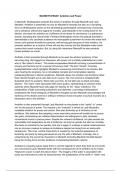
MACBETH ESSAY: Ambition and Power
In Macbeth, Shakespeare presents the theme of ambition through Macbeth and Lady
Macbeth. Ambition is presented not only as Macbeth’s hamartia but also as a corrupting
force as Shakespeare shows us the devastating psychological consequences of pursuing
one’s ambitions without any regard for morality. Lady Macbeth is the inciting force for his
demise, she sees her ambition as a fulfilment of her desire for dominance in a patriarchal
society, disrupting the natural order. Perhaps Shakespeare shows his gradual downfall to
demonstrate to his Jacobean audience the inescapable punishment for those who trade their
honour and spiritual morality for personal, self-serving gain because of their ambition. He
presents ambition as a product of free will and the choices that the Macbeths make which
causes their moral corruption. But, by using foil characters (Macduff) he also presents
honest ambition as moral.
Ambition is first presented through Macbeth as he sees the witches' prophecy of him
becoming king, this triggers his obsession with power. He is initially established as a man
who is "like Valour's minion”. This simile encapsulates Macbeth as being a personification of
bravery and heroism as he’s a servant of bravery itself. The term "minion" connotes
loyalty/dedication which highlights Macbeth's unwavering commitment to his chivalry. But,
upon hearing the prophecy, he is immediately tempted and contemplates regicide
juxtaposing Banquo’s rational scepticism. Macbeth allows his ambition and emotions rather
than rational thought as he uses fate as an excuse. His inner turmoil is metaphorically
illustrated when he exclaims “Stars hide your fires, let not light see my black and deep
desires”. The “stars” were associated with divine justice, representing an external moral
authority which Macbeth fears will judge him harshly for his “deep” intentions. The
juxtaposition of light (connoting purity/truth) and darkness ( connoting evil/deception)
emphasises the moral ambiguity of Macbeth's thoughts but also Macbeth acknowledges the
darkness of his desires and he is willing to embrace moral corruption in pursuit of power as a
transaction due to his ambition.
Ambition is also presented through Lady Macbeth as she pleads to the “spirits” to “unsex
me” for the pursuit of power. The request to be "unsexed" is driven by Lady Macbeth's
insatiable ambition for power and control. She sees femininity as a hindrance to her
ambitions. She believes that adopting a more masculine persona will enable her to pursue
her goals, emphasising her ruthless determination and willingness to defy Jacobean
conventional norms to pursue power. Despite her outward confidence, her plea reveals her
vulnerability and desperation as she is limited by not only her gender but also her mortality.
She feels so restricted by her gender, that she is eager to undergo a radical metamorphosis
into an inhuman creature to escape its limitations despite her being from an aristocratic
background. This inner, central masculinity is masked by her external appearance of
femininity and purity by being perceived as only the wife of Macbeth. Ironically, she is
undermined by the rest of the characters in Macbeth (including Macbeth himself) despite
being the inciting force and her ambitions orchestrating Macbeth’s actions.
Ambition’s corrupting nature leads them to commit regicide in which they both (at one point)
are consumed by guilt. Macbeth deals with the consequences of his ambition as he needs
“Neptune's ocean to wash this blood clean”. The imagery of the water is associated with
purity and memories but also its extensiveness; the juxtaposition of the motif of “water” and
In Macbeth, Shakespeare presents the theme of ambition through Macbeth and Lady
Macbeth. Ambition is presented not only as Macbeth’s hamartia but also as a corrupting
force as Shakespeare shows us the devastating psychological consequences of pursuing
one’s ambitions without any regard for morality. Lady Macbeth is the inciting force for his
demise, she sees her ambition as a fulfilment of her desire for dominance in a patriarchal
society, disrupting the natural order. Perhaps Shakespeare shows his gradual downfall to
demonstrate to his Jacobean audience the inescapable punishment for those who trade their
honour and spiritual morality for personal, self-serving gain because of their ambition. He
presents ambition as a product of free will and the choices that the Macbeths make which
causes their moral corruption. But, by using foil characters (Macduff) he also presents
honest ambition as moral.
Ambition is first presented through Macbeth as he sees the witches' prophecy of him
becoming king, this triggers his obsession with power. He is initially established as a man
who is "like Valour's minion”. This simile encapsulates Macbeth as being a personification of
bravery and heroism as he’s a servant of bravery itself. The term "minion" connotes
loyalty/dedication which highlights Macbeth's unwavering commitment to his chivalry. But,
upon hearing the prophecy, he is immediately tempted and contemplates regicide
juxtaposing Banquo’s rational scepticism. Macbeth allows his ambition and emotions rather
than rational thought as he uses fate as an excuse. His inner turmoil is metaphorically
illustrated when he exclaims “Stars hide your fires, let not light see my black and deep
desires”. The “stars” were associated with divine justice, representing an external moral
authority which Macbeth fears will judge him harshly for his “deep” intentions. The
juxtaposition of light (connoting purity/truth) and darkness ( connoting evil/deception)
emphasises the moral ambiguity of Macbeth's thoughts but also Macbeth acknowledges the
darkness of his desires and he is willing to embrace moral corruption in pursuit of power as a
transaction due to his ambition.
Ambition is also presented through Lady Macbeth as she pleads to the “spirits” to “unsex
me” for the pursuit of power. The request to be "unsexed" is driven by Lady Macbeth's
insatiable ambition for power and control. She sees femininity as a hindrance to her
ambitions. She believes that adopting a more masculine persona will enable her to pursue
her goals, emphasising her ruthless determination and willingness to defy Jacobean
conventional norms to pursue power. Despite her outward confidence, her plea reveals her
vulnerability and desperation as she is limited by not only her gender but also her mortality.
She feels so restricted by her gender, that she is eager to undergo a radical metamorphosis
into an inhuman creature to escape its limitations despite her being from an aristocratic
background. This inner, central masculinity is masked by her external appearance of
femininity and purity by being perceived as only the wife of Macbeth. Ironically, she is
undermined by the rest of the characters in Macbeth (including Macbeth himself) despite
being the inciting force and her ambitions orchestrating Macbeth’s actions.
Ambition’s corrupting nature leads them to commit regicide in which they both (at one point)
are consumed by guilt. Macbeth deals with the consequences of his ambition as he needs
“Neptune's ocean to wash this blood clean”. The imagery of the water is associated with
purity and memories but also its extensiveness; the juxtaposition of the motif of “water” and