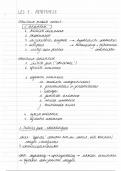
I. CENTRAL DOGMA
A. DNA → RNA: Transcription
1. RNA polymerase produces RNA molecule with cbp to DNA
2. RNA polymerase begins transcription by binding to promoter sequences in DNA w the help
of protiens↳
3. EUkaryotic and bacterial promotor (sigma) vary
4. Eukaryotic basal transcription factors bind to promoter and being transcription. This causes
RNA polymerase to bind to the site.
5. RNA elongates form 5’ → 3’ direction
6. Ends in bacteria when stem-loop forms in transcribed RNA; terminated in eukaryotes after
RNA cleaved downstream of poly(A) signal
B. RNA Processing
1. Initial transcript must be processed to make matrue RNA
2. Splicing primary transcripts removes introns and joins exons
3. MAcromolecular machines called spliceosomes splice the introns out of pre-mRNA
4. 5’ cap added ot end of pre-mRNA and poly(A) tail added to 3’ end
a) Recognition signals for translation; protect message from degredation by
ribonucleases
5. Occurs in nucleus
C. RNA → Protein: Translation
1. Ribosomes translate mRNA into protein using tRNA
2. Bacteria does simultaneous transcription and translation
3. Eukaryotes do it seperately because trasncription in nuceus, and translation in cytoplasm
4. tRNA structure
a) Carries amino acid corresponding to anticodon
b) L shaped tertiary structure, one leg has anticodon
c) Anticodon forms cbp w mRNA
d) aminoacyl-tRNA synthetase links amino acid to tRNA
e) Wobble pairing makes 40 antiocodons translate for 61 codons
5. Ribosomal structure + function
a) Large macromolecular machines made of proteins and RNAs
b) tRNA anticodon binds to mRNA codon to bring correct amino
acid into ribosome
c) Peptide bond catalyzed by ribosome
d) Chaperone protein folds new proteins
e) Usually post-translational modification to activate
D. Vocab: Central Dogma, Transcription & Translation
II. CELLS
A. Bacterial and Arcahel Cells (prokaryotes)
1. Absence of nucleus
2. Has ribosome, cell wall, nucleoid, internal cytoskeleton,
3. Flagella and fimbria
B. Eukaryotic Cells
1. Much larger size causes change in surface area-to-volume ratio
2. Organelles are required to make the rate of exchange of thing in and out of the cell more
efficient
3. Nucleus in eukaryotes contains chromosome and stores information. Enclosed by double
membrane nuclear enevelope and has nuclear lamina lining the inside surgace of
membrane. Nucleolus is where RNA are dound in ribosomes and manufactured.
4. Ribosomes manufacturing proteins in cytoplasm
5. Endoplasmic reticulum has single membrane continuous w nuclear envelope.
a) RER: Proteins are manufactured on ribosomes attached to the surgafe of the
membrane and then they are processed in the lumen until they are later shipped
off.
b) SER: lipids are synthesized by enzymes or enzymes break down molecules or
lipids. Resevoir of calcium ions
6. Golgi Apparatus is like the mail room where protins pass before going to final
destination. Stacks of membranous sacs called cisternae. There is cis side where vesicles
are recieved w ER products “cargo” and trans side ships the processed proteins out to
their destinations in vesicles
7. Lysosomes are recycling centers that hydrolyz macromolecules and export them to cytosol to be used to make new
molecules
8. Endomembrane system
9. Vacuole is similar to lysosome for plants which stores ions, digesting proteins into amino acids and
10. Peroxisomes are used for redox equations
11. Mitochondria is dual membrane organele that generates ATP for the cell. Inner membrane made up of sacs called cristae
that have mitochondrial matrix which is where most of the ATP is made; mitochondrial DNA
, ;
12. Chloroplast makes sunlight into chemical energy and has flattened thylakoids throughout its interior in stacks called
grana; stroma is similar to mitochondrial matrix containing enzymes that use chemcial energy to make sugars
13. Endosymbiosis : mitochondria and chloroplasts divide seperately and have DNA so were probably bacteria engulfed by
ancestors but developed mutual relationship
, 14. Cell wall in plasnts resisting pressure and providing structural support made up of polysaccharides and protines; outside
plasma membrane
C. Studying the cell
1. Structures of cell varies tremendously based off of function
a) Size and number of different types of organelles correlates with its function
2. Differential centrifugation allows researchers to isolate cellular components and break cells apart into mixture separating
componenets in centrifuge.
3. Dynamic cells
D. Vocab: Cells
III. LIPIDS AND MEMBRANES
A. Lipid Structure
1. Mostly hydrophobic because hydrocarbons
2. Fatty acid store chemical energy
a) Fatty acid is hydrocarbon with carboxyl group
b) Kinks caused by unsaturation (double bond)
c) Steroids and phospholipids are key parts of
membranes
d) Length and degree of saturation has effect on
properties
3. Fats, steroids and phospholipids; differ in structure and
function
a) Steroids
(1) Four ring structure and then
functional and side groups
attached to the hydrophobic rings
(2) Tail at bottom
b) Fats store chemical energy
(1) Three fatty acid → fats =
triacylglycerols = triglycerides
(2) Fatty acids joined by ester linkage
c) Phospholipids in membranes
(1) Hydrophilic head
(2) Hydrophobic tail - fatty acids in
eukaryotes and bacteria,
isoprenoids in archaea
d) Amphipathic lipids also have hydrophillic
region containing polar or charged groups.
Phospholipids have charged had that
makes them amphipathic. Nonpolar tail is
usaully fatty acid or isoprenoid
B. Lipid Bilayers
1. Spontaneously assemble into bilayer that is barrier between external and internal environments
a) Micelles and phospholipid bilayer
(1) Micelles single hydrocarbon chains
(2) Phospholipids have two hydrocarbon tails
b) Heads face surrounding solution and tails face each other
2. Small nonpolar molecules can move across lipid bilayer readily
a) Selective permeability- only some things can pass through membrane
3. Ions cross rarely
4. Permeability and fluidity related to many things
a) Cholesterol → decreases permeability
b) Temperature
(1) As temperature increases so does permeability
c) Chemical strucutre of lipid - saturation and length
(1) Unsaturated hydrocarbons have kinks which increase permeability
C. Osmosis and Diffusion
1. Diffusion = random movement of ions/molecules due to thermal energy
2. Passive transport results in directional movement of solutes across a membrane that
makes the environments more similar
a) Result in differing concentrations
b) Spontaneous and driven by entropy
c) High to low concentraion
d) Hypertonic = higher concentraion of solutes
outside cell; water leaves cell
e) Hypotonic = lower concentration of solutes
outside cell; water enters cell
A. DNA → RNA: Transcription
1. RNA polymerase produces RNA molecule with cbp to DNA
2. RNA polymerase begins transcription by binding to promoter sequences in DNA w the help
of protiens↳
3. EUkaryotic and bacterial promotor (sigma) vary
4. Eukaryotic basal transcription factors bind to promoter and being transcription. This causes
RNA polymerase to bind to the site.
5. RNA elongates form 5’ → 3’ direction
6. Ends in bacteria when stem-loop forms in transcribed RNA; terminated in eukaryotes after
RNA cleaved downstream of poly(A) signal
B. RNA Processing
1. Initial transcript must be processed to make matrue RNA
2. Splicing primary transcripts removes introns and joins exons
3. MAcromolecular machines called spliceosomes splice the introns out of pre-mRNA
4. 5’ cap added ot end of pre-mRNA and poly(A) tail added to 3’ end
a) Recognition signals for translation; protect message from degredation by
ribonucleases
5. Occurs in nucleus
C. RNA → Protein: Translation
1. Ribosomes translate mRNA into protein using tRNA
2. Bacteria does simultaneous transcription and translation
3. Eukaryotes do it seperately because trasncription in nuceus, and translation in cytoplasm
4. tRNA structure
a) Carries amino acid corresponding to anticodon
b) L shaped tertiary structure, one leg has anticodon
c) Anticodon forms cbp w mRNA
d) aminoacyl-tRNA synthetase links amino acid to tRNA
e) Wobble pairing makes 40 antiocodons translate for 61 codons
5. Ribosomal structure + function
a) Large macromolecular machines made of proteins and RNAs
b) tRNA anticodon binds to mRNA codon to bring correct amino
acid into ribosome
c) Peptide bond catalyzed by ribosome
d) Chaperone protein folds new proteins
e) Usually post-translational modification to activate
D. Vocab: Central Dogma, Transcription & Translation
II. CELLS
A. Bacterial and Arcahel Cells (prokaryotes)
1. Absence of nucleus
2. Has ribosome, cell wall, nucleoid, internal cytoskeleton,
3. Flagella and fimbria
B. Eukaryotic Cells
1. Much larger size causes change in surface area-to-volume ratio
2. Organelles are required to make the rate of exchange of thing in and out of the cell more
efficient
3. Nucleus in eukaryotes contains chromosome and stores information. Enclosed by double
membrane nuclear enevelope and has nuclear lamina lining the inside surgace of
membrane. Nucleolus is where RNA are dound in ribosomes and manufactured.
4. Ribosomes manufacturing proteins in cytoplasm
5. Endoplasmic reticulum has single membrane continuous w nuclear envelope.
a) RER: Proteins are manufactured on ribosomes attached to the surgafe of the
membrane and then they are processed in the lumen until they are later shipped
off.
b) SER: lipids are synthesized by enzymes or enzymes break down molecules or
lipids. Resevoir of calcium ions
6. Golgi Apparatus is like the mail room where protins pass before going to final
destination. Stacks of membranous sacs called cisternae. There is cis side where vesicles
are recieved w ER products “cargo” and trans side ships the processed proteins out to
their destinations in vesicles
7. Lysosomes are recycling centers that hydrolyz macromolecules and export them to cytosol to be used to make new
molecules
8. Endomembrane system
9. Vacuole is similar to lysosome for plants which stores ions, digesting proteins into amino acids and
10. Peroxisomes are used for redox equations
11. Mitochondria is dual membrane organele that generates ATP for the cell. Inner membrane made up of sacs called cristae
that have mitochondrial matrix which is where most of the ATP is made; mitochondrial DNA
, ;
12. Chloroplast makes sunlight into chemical energy and has flattened thylakoids throughout its interior in stacks called
grana; stroma is similar to mitochondrial matrix containing enzymes that use chemcial energy to make sugars
13. Endosymbiosis : mitochondria and chloroplasts divide seperately and have DNA so were probably bacteria engulfed by
ancestors but developed mutual relationship
, 14. Cell wall in plasnts resisting pressure and providing structural support made up of polysaccharides and protines; outside
plasma membrane
C. Studying the cell
1. Structures of cell varies tremendously based off of function
a) Size and number of different types of organelles correlates with its function
2. Differential centrifugation allows researchers to isolate cellular components and break cells apart into mixture separating
componenets in centrifuge.
3. Dynamic cells
D. Vocab: Cells
III. LIPIDS AND MEMBRANES
A. Lipid Structure
1. Mostly hydrophobic because hydrocarbons
2. Fatty acid store chemical energy
a) Fatty acid is hydrocarbon with carboxyl group
b) Kinks caused by unsaturation (double bond)
c) Steroids and phospholipids are key parts of
membranes
d) Length and degree of saturation has effect on
properties
3. Fats, steroids and phospholipids; differ in structure and
function
a) Steroids
(1) Four ring structure and then
functional and side groups
attached to the hydrophobic rings
(2) Tail at bottom
b) Fats store chemical energy
(1) Three fatty acid → fats =
triacylglycerols = triglycerides
(2) Fatty acids joined by ester linkage
c) Phospholipids in membranes
(1) Hydrophilic head
(2) Hydrophobic tail - fatty acids in
eukaryotes and bacteria,
isoprenoids in archaea
d) Amphipathic lipids also have hydrophillic
region containing polar or charged groups.
Phospholipids have charged had that
makes them amphipathic. Nonpolar tail is
usaully fatty acid or isoprenoid
B. Lipid Bilayers
1. Spontaneously assemble into bilayer that is barrier between external and internal environments
a) Micelles and phospholipid bilayer
(1) Micelles single hydrocarbon chains
(2) Phospholipids have two hydrocarbon tails
b) Heads face surrounding solution and tails face each other
2. Small nonpolar molecules can move across lipid bilayer readily
a) Selective permeability- only some things can pass through membrane
3. Ions cross rarely
4. Permeability and fluidity related to many things
a) Cholesterol → decreases permeability
b) Temperature
(1) As temperature increases so does permeability
c) Chemical strucutre of lipid - saturation and length
(1) Unsaturated hydrocarbons have kinks which increase permeability
C. Osmosis and Diffusion
1. Diffusion = random movement of ions/molecules due to thermal energy
2. Passive transport results in directional movement of solutes across a membrane that
makes the environments more similar
a) Result in differing concentrations
b) Spontaneous and driven by entropy
c) High to low concentraion
d) Hypertonic = higher concentraion of solutes
outside cell; water leaves cell
e) Hypotonic = lower concentration of solutes
outside cell; water enters cell