Klinisch redeneren – knie
THEORIE
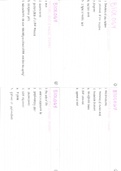
Clinical examination
Cause of lateral knee pain:
Biggest difference running and walking:
walking: 2 phases of double support, ground reaction force =120%
running: none, flight fase (no support), ground reaction force= 2-3x body weight
Running
There is not only 1 perfect running style
1st part (<50% support phase): subtalar/ forefoot pronation, talocrural-DF, tibia IR, knee-
valgus+FL, hipFL+ ADD-ENDO
2nd part (>50% support phase): subtalar/forefoot-supination, talocrural PF, tibia ER, knee-
varus + EXT, hipEXT + ABD-EXO
ITBS
= iliotibial band syndrome
2nd most common running injury, most common reason for lateral knee pain in runners,
women > men
due to overuse injuries in cyclists and walkers
function: the attachemtns of the ITB to the pelvis, femur and tibia mean that it passively
resist hip adduction and internal rotation as well as anterior translation of the tibia
general complaints:
- pain over the lateral aspect of the knee
- influences ADL activity (descending/ascending stairs)
- pain starts fast
- pain aggravates
examination:
- palpation: lateral femural epicondyle, some cm above the joint line
- Noble test: palpation test with movement of the knee from 90° -0°, lateral pressure while
doing movement + when reproducing pain
- Ober’s test: identification of thightness ITband , unaffected side on the bottom, shoulder
and pelvis in line <20° below horizontal line = atypical, related to ITB
- myofascial: TFL/glutes/ vastus lateralis give pain to the zone of the IT band
, compression = cause, not friction
repetitive compression of subfascial fat between ITB and femur: good vascularization ->
pain -> highest at 30° of knee flexion, increased during medial tibial rotation
when the knee straightens/ tibia rotates outwards -> compression reduced
- loading phase: compression, knee bends after landing, both tibia and femur roll inwards
- propulsion phase: roll outwards -> less compression
- fatigue -> bigger movements -> more compression
- possible abnormal hip and foot mechanism (ITB = knee and hip stabilizer, resists ADD and
IR) -> more tibial rotation -> more compressive forces -> distal attachment = more medially
- ADD hip = more strain in ITB
- internal rotation knee = torsion strain on ITB -> injury
- pelvic drop
- ipsilateroflexion
ITBS occurs in the deceleration phase of stance-phase running
the sagittal plane has not been firmly established as a risk factor for injury except for the
impingement zone at around 30° of flexion
more consistently kinematic factors to ITBS have been identified in the frontal and
transverse planes
Not every P has the same movement pattern, a lot of contradictorial evidence
Contributing factors
- weakness in the lateral and posterior hip musculature: less ABD or ER strength ADD
ITB strain
- narrow foot placement -> more ITB strain rate, ADD
both: excessive lengthening ITB
Underlying mechanism ITBS = mutifactorial
evaluate running kinematics, muscle weakness, flexibility and anatomic factors
keep poor training (too much, too fast) and poor footwear in mind
Lateral meniscus
- more circular
- more mobile
- medial meniscus tears = more common
- inner 2/3 = avascular, outer 1/3 is vascular
- medal meniscus: 50% load, lateral meniscus: 70% load
resection: peak load lat > med
- etiology:
acute: flexion/compression/rotation/hyperextension
degenerative: anamnesis = similar to ITBS (after few minutes of running due to too much
load on joint), slowly developing lesion, middle aged (30-40j) or older, frequent in general
population, no acute knee injury
- tests (possibly negative when degenerative):
apley compression test
THEORIE
Clinical examination
Cause of lateral knee pain:
Biggest difference running and walking:
walking: 2 phases of double support, ground reaction force =120%
running: none, flight fase (no support), ground reaction force= 2-3x body weight
Running
There is not only 1 perfect running style
1st part (<50% support phase): subtalar/ forefoot pronation, talocrural-DF, tibia IR, knee-
valgus+FL, hipFL+ ADD-ENDO
2nd part (>50% support phase): subtalar/forefoot-supination, talocrural PF, tibia ER, knee-
varus + EXT, hipEXT + ABD-EXO
ITBS
= iliotibial band syndrome
2nd most common running injury, most common reason for lateral knee pain in runners,
women > men
due to overuse injuries in cyclists and walkers
function: the attachemtns of the ITB to the pelvis, femur and tibia mean that it passively
resist hip adduction and internal rotation as well as anterior translation of the tibia
general complaints:
- pain over the lateral aspect of the knee
- influences ADL activity (descending/ascending stairs)
- pain starts fast
- pain aggravates
examination:
- palpation: lateral femural epicondyle, some cm above the joint line
- Noble test: palpation test with movement of the knee from 90° -0°, lateral pressure while
doing movement + when reproducing pain
- Ober’s test: identification of thightness ITband , unaffected side on the bottom, shoulder
and pelvis in line <20° below horizontal line = atypical, related to ITB
- myofascial: TFL/glutes/ vastus lateralis give pain to the zone of the IT band
, compression = cause, not friction
repetitive compression of subfascial fat between ITB and femur: good vascularization ->
pain -> highest at 30° of knee flexion, increased during medial tibial rotation
when the knee straightens/ tibia rotates outwards -> compression reduced
- loading phase: compression, knee bends after landing, both tibia and femur roll inwards
- propulsion phase: roll outwards -> less compression
- fatigue -> bigger movements -> more compression
- possible abnormal hip and foot mechanism (ITB = knee and hip stabilizer, resists ADD and
IR) -> more tibial rotation -> more compressive forces -> distal attachment = more medially
- ADD hip = more strain in ITB
- internal rotation knee = torsion strain on ITB -> injury
- pelvic drop
- ipsilateroflexion
ITBS occurs in the deceleration phase of stance-phase running
the sagittal plane has not been firmly established as a risk factor for injury except for the
impingement zone at around 30° of flexion
more consistently kinematic factors to ITBS have been identified in the frontal and
transverse planes
Not every P has the same movement pattern, a lot of contradictorial evidence
Contributing factors
- weakness in the lateral and posterior hip musculature: less ABD or ER strength ADD
ITB strain
- narrow foot placement -> more ITB strain rate, ADD
both: excessive lengthening ITB
Underlying mechanism ITBS = mutifactorial
evaluate running kinematics, muscle weakness, flexibility and anatomic factors
keep poor training (too much, too fast) and poor footwear in mind
Lateral meniscus
- more circular
- more mobile
- medial meniscus tears = more common
- inner 2/3 = avascular, outer 1/3 is vascular
- medal meniscus: 50% load, lateral meniscus: 70% load
resection: peak load lat > med
- etiology:
acute: flexion/compression/rotation/hyperextension
degenerative: anamnesis = similar to ITBS (after few minutes of running due to too much
load on joint), slowly developing lesion, middle aged (30-40j) or older, frequent in general
population, no acute knee injury
- tests (possibly negative when degenerative):
apley compression test