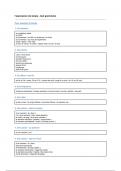
Practical Notes
Needed:
- Pencils
- Calculator
- Ruler
- Pens
- Eraser
- A watch
Not allowed:
- Cell phone
- Tippex
Structure:
(Two parts are not related)
Part A
= experimental design of an experiment
Part B
= performing an experiment according to the given instructions
Validity
(has to do with variables)
Ensure that:
1 dependent
1 independent
All others MUST be fixed
Reliability
(has to do with repetition)
Repeating the experiment or enlarging the sample size.
Ensure that the experiment can be repeated under the same conditions and will generate the
same results.
If asked to improve:
- Increase sample size
- Repeat the investigations
- Take many reading and use an average
- Select a random sample
Accuracy
Ensuring that the apparatus is used properly.
E.g. Reading the bottom of the meniscus for a graduated cylinder.
Take the reading of liquids at eye level.
Avoid contamination.
To use a syringe accurately: invert the syringe and tap the upper part to remove air bubbles.
To use a measuring spoon accurately: ensure that you fill the spoon and then level it using a flat
object.
Fair test
= The way that the experimental and control are set up to ensure that they differ by only the
independent variable
, The aim
= describes what the experiment is trying to find out.
To investigate ...
The hypothesis
= a statement that connects the independent variable and the dependant variable.
If ... then ...
Independent variable
= the variable that you change in the experiment
Only one
Goes on the x-axis of a graph
Goes in the first column of a table
Dependent variable
= the variable that you will measure at the end of the experiment
Only one
Goes on the y-axis of a graph
Goes in the second column of a table
The control
= set up exactly the same as the experiment, but without the independent variable
The function of the control is to see if the experiment still works without the independent variable
(to provide a suitable mean of comparison)
Not always applicable
Fixed variables
= the things that are kept constant, ensuring a fair test
More than one
Method:
- Always include all apparatus and how it is used
- Specify the unit
- Include all substances and their quantities
- Use a numbered format
- State how to collect and record results
- Include what results mean
- Keep the aim in mind
- Ensure a logical order
- Start each step on a new line
Needed:
- Pencils
- Calculator
- Ruler
- Pens
- Eraser
- A watch
Not allowed:
- Cell phone
- Tippex
Structure:
(Two parts are not related)
Part A
= experimental design of an experiment
Part B
= performing an experiment according to the given instructions
Validity
(has to do with variables)
Ensure that:
1 dependent
1 independent
All others MUST be fixed
Reliability
(has to do with repetition)
Repeating the experiment or enlarging the sample size.
Ensure that the experiment can be repeated under the same conditions and will generate the
same results.
If asked to improve:
- Increase sample size
- Repeat the investigations
- Take many reading and use an average
- Select a random sample
Accuracy
Ensuring that the apparatus is used properly.
E.g. Reading the bottom of the meniscus for a graduated cylinder.
Take the reading of liquids at eye level.
Avoid contamination.
To use a syringe accurately: invert the syringe and tap the upper part to remove air bubbles.
To use a measuring spoon accurately: ensure that you fill the spoon and then level it using a flat
object.
Fair test
= The way that the experimental and control are set up to ensure that they differ by only the
independent variable
, The aim
= describes what the experiment is trying to find out.
To investigate ...
The hypothesis
= a statement that connects the independent variable and the dependant variable.
If ... then ...
Independent variable
= the variable that you change in the experiment
Only one
Goes on the x-axis of a graph
Goes in the first column of a table
Dependent variable
= the variable that you will measure at the end of the experiment
Only one
Goes on the y-axis of a graph
Goes in the second column of a table
The control
= set up exactly the same as the experiment, but without the independent variable
The function of the control is to see if the experiment still works without the independent variable
(to provide a suitable mean of comparison)
Not always applicable
Fixed variables
= the things that are kept constant, ensuring a fair test
More than one
Method:
- Always include all apparatus and how it is used
- Specify the unit
- Include all substances and their quantities
- Use a numbered format
- State how to collect and record results
- Include what results mean
- Keep the aim in mind
- Ensure a logical order
- Start each step on a new line