T1 Finance
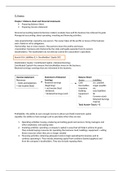
Chapter 1 Balance sheet and Financial statements
Preparing Balance Sheet
Preparing Income statement
Financial accounting:(external decision makers) evaluate how well the business has achieved its goals
Managerial accounting: about operating, investing and financing activities.
-Sole proprietorship: owned by one person. The owner takes all the profits or losses of the business
and is liable for all its obligations.
-Partnership: two or more owners. The partners share the profits and losses.
-Corporation: business unit chartered by the state and legally separate from its owners
(stockholders). The stockholders do not directly control the corporation’s operations.
Assets (A)= Liabilities (L) + Stockholders’ Equity (SE)
Stockholders’ Equity= Contributed Capital + Retained Earnings
Contributed Capital= the amount that stockholders invest in the business.
Retained earnings: earnings that are reinvested in the business.
Statement of Retained Balance Sheet
Earnings Assets Liabilities
Retained earnings Cash acc. payable
(beginning) Receivables wages payable
+ net income (loss) Inventory etc.
-dividends Building total liabilities
= Retained Earnings (end) Equipment SE
Etc. Common stock
Retained Earnings
Total SE
Total Assets= Total L + E
Profitability: the ability to earn enough income to attract and hold investment capital
Liquidity: the ability to have enough cash to pay debts when they are due
1. Operating activities: buying, producing and selling goods and services: hiring managers and
other employees; and paying taxes
2. Investing activities: spending a company’s capital in ways that will help it achieve its goals.
They include buying resources for operating the business: land, buildings, equipment + selling
those resources when they are no longer needed
3. Financing activities: obtaining adequate funds to begin operating the business and to
continue operating it. They include obtaining capital from creditors (banks/suppliers) and
from the company’s stockholders. They also include repaying them.
, Chapter 2 Business Transactions
Journals- T Accounts
Prepare Trail Balance
Double-Entry System: each transaction must be recorded with at least one debit and one credit, and
the total amount of the debits must equal the total amount of credits.
Assets Liabilities Stockholders’ Equity Revenues Expense
Cash Notes payable Common stock Service Wages
revenue expense
Notes receivable Accounts payable Retained earnings Utilities
expense
Accounts receivable Unearned dividends Telephone
revenue: advance expense
deposits for
services to be
provided in the
future
Office supplies Wages payable Income summary: Rent expense
temporary account
used at the end of
the accounting
period to summarize
revenues + expenses
Prepaid rent: prepaid Income taxes Insurance
expense, rent paid in payable expense
advance and not used
Prepaid insurance Office supplies
expense
Land Depreciation
expense
buildings
Buildings Depreciation
expense
equipment
Accumulated Income taxes
Depreciation buildings expense
Equipment
Accum. depreciation
equipment
- Assets, dividends and expenses are always increased by debits
Stockholders’ Equity
Assets = liabilities + common stock + retained earnings - dividends + revenue - expenses
x x x x x x x
on account/ not paid yet = acc. Payable on credit
Chapter 1 Balance sheet and Financial statements
Preparing Balance Sheet
Preparing Income statement
Financial accounting:(external decision makers) evaluate how well the business has achieved its goals
Managerial accounting: about operating, investing and financing activities.
-Sole proprietorship: owned by one person. The owner takes all the profits or losses of the business
and is liable for all its obligations.
-Partnership: two or more owners. The partners share the profits and losses.
-Corporation: business unit chartered by the state and legally separate from its owners
(stockholders). The stockholders do not directly control the corporation’s operations.
Assets (A)= Liabilities (L) + Stockholders’ Equity (SE)
Stockholders’ Equity= Contributed Capital + Retained Earnings
Contributed Capital= the amount that stockholders invest in the business.
Retained earnings: earnings that are reinvested in the business.
Statement of Retained Balance Sheet
Earnings Assets Liabilities
Retained earnings Cash acc. payable
(beginning) Receivables wages payable
+ net income (loss) Inventory etc.
-dividends Building total liabilities
= Retained Earnings (end) Equipment SE
Etc. Common stock
Retained Earnings
Total SE
Total Assets= Total L + E
Profitability: the ability to earn enough income to attract and hold investment capital
Liquidity: the ability to have enough cash to pay debts when they are due
1. Operating activities: buying, producing and selling goods and services: hiring managers and
other employees; and paying taxes
2. Investing activities: spending a company’s capital in ways that will help it achieve its goals.
They include buying resources for operating the business: land, buildings, equipment + selling
those resources when they are no longer needed
3. Financing activities: obtaining adequate funds to begin operating the business and to
continue operating it. They include obtaining capital from creditors (banks/suppliers) and
from the company’s stockholders. They also include repaying them.
, Chapter 2 Business Transactions
Journals- T Accounts
Prepare Trail Balance
Double-Entry System: each transaction must be recorded with at least one debit and one credit, and
the total amount of the debits must equal the total amount of credits.
Assets Liabilities Stockholders’ Equity Revenues Expense
Cash Notes payable Common stock Service Wages
revenue expense
Notes receivable Accounts payable Retained earnings Utilities
expense
Accounts receivable Unearned dividends Telephone
revenue: advance expense
deposits for
services to be
provided in the
future
Office supplies Wages payable Income summary: Rent expense
temporary account
used at the end of
the accounting
period to summarize
revenues + expenses
Prepaid rent: prepaid Income taxes Insurance
expense, rent paid in payable expense
advance and not used
Prepaid insurance Office supplies
expense
Land Depreciation
expense
buildings
Buildings Depreciation
expense
equipment
Accumulated Income taxes
Depreciation buildings expense
Equipment
Accum. depreciation
equipment
- Assets, dividends and expenses are always increased by debits
Stockholders’ Equity
Assets = liabilities + common stock + retained earnings - dividends + revenue - expenses
x x x x x x x
on account/ not paid yet = acc. Payable on credit