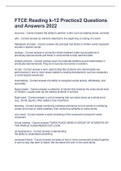
FTCE Reading k-12 Practice2 Questions and Answers 2022
accuracy - Correct answer-the ability to perform a skill, such as reading words, correctly affix - Correct answer-an element attached to the beginning or ending of a word Alphabetic principle - Correct answer-the principle that letters in written words represent sounds in spoken words analogy - Correct answer-a connection drawn between letter-sound patterns in previously learned words and those in novel words to help read the latter. Analytic phonics - Correct answer-Learn to understand letters-sound relationships in previously learned words. They do not pronounce words in isolation. At-risk - Correct answer-a term used to describe students who demonstrate low performance in one or more areas related to reading development, such as vocabulary or phonological awareness Automaticity - Correct answer-the ability to recognize words quickly, effortlessly, and accurately Basal reader - Correct answer-a collection of stories that matches the instructional level of children, usually seen as the reading textbook in schools Base word - Correct answer-a unit of meaning that can stand alone as a whole word (e.g., friend, pig etc.) Also called a free morpheme blending - Correct answer-combining individual phonemes to form words or combining onsets and rimes to make syllables, then combining syllables to make words. ccvc word - Correct answer-a word consisting of the consonant-consonant-vowelconsonant choral reading - Correct answer-TAKES PLACE WHEN A GROUP OF STUDENTS OR THE WHOLE CLASS READS OUT LOUD. comprehension - Correct answer-understanding the ability to understand something consonant blend - Correct answer-constists of two or more consonants sonded together in such a way that each is heard- like the blend of b and l in the word blend. consonant digraph - Correct answer-Two consonants that represent one speech sound. (Examples: ch, sh, th) Consonant letters - Correct answer-all alphabet letters other than vowels content words - Correct answer-nouns, verbs, adjectives, adverbs context - Correct answer-the words and sentences occurring before and after an unknown word that provide hints about its meaning conventional spelling - Correct answer-The fifth and final stage of developmental spelling in which spellers develop over years of word study and writing. Correct spelling can be categorized by instruction levels. For example, correct spelling for a corpus. . . words that can be spelled by the average fourth grader would be fourth grade level correct spelling. Place the word in this category if it is listed correctly. cooperative learning - Correct answer-Approach to instruction in which students work with a small group of peers to achieve a common goal and help one another learn. Cross-age tutoring - Correct answer-Peer tutoring in which older students work with younger students. CVC word - Correct answer-a word consisting of consonant-vowel-consonant CVCC word - Correct answer-a word consisting of the consonant-vowel-consonantconsonant pattern CVCE word - Correct answer-a word consisting of a consonant-vowel-consonant-silent e pattern decodable text - Correct answer-text in which most of the words are made up of soundletter relationships that have been taught, but that contain enough high-frequency irregular, and story words to make them sound natural. decoding - Correct answer-interpretation of the language and symbols sent by the source through a channel dialect - Correct answer-Geographically distinct versions of a single language that vary somewhat from the parent form. dyslexia - Correct answer-a learning disability that results in difficulty reading and writing explicit instruction - Correct answer-An instructional strategy that emphasizes group instruction . The instruction offered should include a great deal of teacher-student interactivity. explicit question - Correct answer-a type of question where the answer is in the text fluency - Correct answer-(n.) spoken or written with ease, particularly as related to a language; (adj.) easy and graceful; flowing Frustration level text - Correct answer--For children reading at level L or higher, frustration is determined when a child can read with 98% or better accuracy but has unsatisfactory comprehension. genre - Correct answer-A category or type of literature (or of art, music, etc.) characterized by a particular form, style, or content. grenade-level text - Correct answer-text for which students of a given grade should have the necessary comprehension, vocabulary, and word recognition skills to read independently grapheme - Correct answer-The individual letter or sequence of written symbols ( /a/, /b/, /c/) & the multiletter units (/ch/, /sh/, /th/) that are used to represent a single phoneme. graphic organizer - Correct answer-a tool that helps to organize ideas and can be used to visually illustrate ideas graphophonemic knowledge - Correct answer-KNOWLEDE ABOUT SPECIFIC RELATIONSHIPS BETWEEN GRAPHEMS AND PHONEMS. guided reading - Correct answer-teacher explains the purpose for reading a particular text as well as the structure for how to respond to what is read. implicit question - Correct answer-We name the question that links premises and conclusion together in the author's thinking. Conclusions are answers to the implicit question. independent-level text - Correct answer-text for which the reader has sufficient word recognition and comprehension skills to read the text easily and fluently without assistance instructional level text - Correct answer-Challenging but manageable text for the reader, with no more than approximately 1 in 10 words difficult for the reader. (90% success). invented spelling - Correct answer-The spelling that novices create before learning conventional writing systems. It is sometimes referred to as temporary, developmental or transitional spelling. irregular word - Correct answer-A word that cannot be decoded because either the sounds of the letters are unique to that word or that the word does not adhere to the common rules of phonics. learning disability - Correct answer-Deficiency in one or more specific cognitive processes despite relatively normal cognitive functioning in other areas. letter-sound correspondence - Correct answer-the knowledge of the sounds that are associated with each letter of the alphabet letter knowledge - Correct answer-basic knowledge of the alphabet and what sounds each letter makes; foundational for literacy accquisition listening comprehension - Correct answer-L2 learners are able to understand more than they can produce. Intensive development of listening activities is essential in early stages of second language acquistion. Comprehension precedes production (speaking/writing). Before students produce an utterance in a second language, they must make choices based on the information they understand/master. listening vocabulary - Correct answer-*words we recognize and understand in oral language long vowel - Correct answer-The vowel sounds that are also names of the alphabet letters main idea - Correct answer-The author's central thought; the chief topic of a text expressed or implied in a word or phrase; the topic sentence of a paragraph. matthew effect - Correct answer-the phenomenon that suggests that skilled decoders get better at reading while poor decoders tend to fall further behind. morpheme - Correct answer-in a language, the smallest unit that carries meaning; may be a word or a part of a word (such as a prefix) morphology - Correct answer-Combining morphemes and free morphemes to make meaningful language. the smallest unit of language narrative text - Correct answer-The purpose of narrative text is to entertain, to tell a story, or to provide an aesthetic literary experience. Narrative text is based on life experiences and is person-oriented using dialogue and familiar language. onset-rime instruction - Correct answer-the use of word patterns to read unfamiliar words orthography - Correct answer-a system of written language that includes the formation of letters and spelling of words partner reading - Correct answer-the process of reading in pairs PEER TUTORING - Correct answer-A method used to integrate students with disabilities into general education settings. It is based on research that demonstrates that students can effectively tutor one another. It maximizes active student engagement with an academic task and can also improve social and communication skills. One particularly effective form is Classwide Peer Tutoring (CWPT). phoneme - Correct answer-in language, the smallest distinctive sound unit phonemic awareness - Correct answer-REFERS TO CHILD'S ABILITY TO UNDERSTAND THAT WORDS HAVE SMALLER COMPONENTS CALLED SOUNDS, AND THAT THESE SOUNDS TOGETHER CREATE SYLLABLES AND WORDS. phonics - Correct answer-Involves teaching children to connect sounds with letters or groups of letters. Example: (K) can be represented by C, K, or Ch spellings. phonological awareness - Correct answer-an awareness of an the ability to manipulate the sounds of sponken words; it is a broad tern that includes indentifying and making rhymes, recognizing alliteration, identifying and working with syllables in spoken words, identifying and working with onsets and rhymes in spoken syllables. phonology - Correct answer-The study of the patterns and distributions of speech sounds in a language and the tacit rules for their pronunciation. prefix - Correct answer-a syllable or word that comes before a root word to change its meaning a syllable or word that comes before a root word to change its meaning print concepts - Correct answer-basic features of written language such as identifying the front and back of a book, directionality, and spoken and written language matching. progress monitoring - Correct answer-assessing student's learning through direct and frequent assessments directly on the target of concern prosody - Correct answer-the use of appropriate intonation and phrasing when reading; reading with expression reading - Correct answer-A process by which we construct meaning from print. reading comprehension - Correct answer-Main idea, supporting details and facts, author's purpose, fact and opinion, point of view, inference, visualize, conclusion The ability to read text, process it and understand its meaning. reading level - Correct answer-determine reading levels using word recognition lists (graded word lists) which provide a rough guess of child's reading level, lets teacher know what words the student can correctly identify, and how well students can decode words repeated reading - Correct answer-WHERE CHILDREN REREAD A HORT, MEANINGFUL PASSAGE UNTIL A DEGREE OF FLUENCY IS ACHIEVED. rhyme - Correct answer-Correspondence of sound between words or the endings of words, especially when these are used at the ends of lines of poetry. scaffolded instruction - Correct answer-Teachers provide temporary support to a student who is not ready to perform a task independently. As the student gains confidence/skill, this support is slowly taken away until the student can function independently. segmenting - Correct answer-breaking words into individual phonemes, breaking words into syllables, or breaking syllables into onsets and rimes. sight words - Correct answer-a word whose spelling is such that it can not be pronounced correctly just by sounding it out according to the rules. The reader recognizes sight words from having memorized them or by drawing their meaning from context. speaking vocabulary - Correct answer-The words used when speaking. story structure - Correct answer-the way an author writes such as plot, series of events, conflict, or problem; and how the conflict is resolved. summarizing - Correct answer-Briefly stating the main points and key details of a work in your own words. syllabe - Correct answer-is a unit of pronunciation that has one vowel sound synthetic phonics - Correct answer-A method of teaching reading in which sounds within words are taught as sounds and then synthesized into words. For example, the teacher would say, "listen to the 'sssss' sound." systematic instruction - Correct answer-a planned, sequential program of instruction tape assisted reading - Correct answer-Students read along in their books as they hear a fluent reader read the book on an audiotape text - Correct answer-the words composing written material such as a story, newspaper article, or sections of a textbook text structure - Correct answer-The structure of the text or how the author chooses to organize the text. think-aloud - Correct answer-A modeling activity in which the teacher verbalizes the teacher's thoughts while reading; used to model ways in which skilled readers make predictions, use visulization, related prior knowledge, and moitor and self-correct their comprehensions. word analysis - Correct answer-REFERS TO THE WAY THAT CHILDREN APPROACH A WRITTEN WORD IN ORDER TO DECODE AND OBTAIN MEANING FROM IT. word family - Correct answer-VOCABULARY A group of words that share the same root but have different affixes: care, careful, careless, carefree, uncaring, carer. A base word plus its inflections and its most common derivatives. word recognition - Correct answer-the process of automatically determining the pronunciation and some degree of the meaning of an unknown word. Louise Rosenblatt - Correct answer-creator fo Transactional Theory of reading, where meaning arises from the trasnaction between reader and text and the reader enters reading the text with their own knowledge. Noam Chomsky - Correct answer-language development; disagreed with Skinner about language acquisition, stated there is an infinite # of sentences in a language, humans have an inborn native ability to develop language Lev Vygotsky - Correct answer-child development; investigated how culture & interpersonal communication guide development; zone of proximal development; play research Paulo Freire - Correct answer-; critical pedagogy movement; emphasis on dialogue and concern with the oppressed Cognitive development - Correct answer-development of processes of knowing, including imagining, perceiving, reasoning, and problem solving social constructivist - Correct answer-An approach that emphasizes the social contexts of learning and that knowledge is mutually built and constructed. Vygotsky's theory reflects this approach. discovery learning - Correct answer-Teaching methods that enable students to discover information by themselves or in groups. reader response - Correct answer-theory that puts the focus on the reader of a text and his or her experience with it
Written for
- Institution
- FTCE Reading k-12
- Course
- FTCE Reading k-12
Document information
- Uploaded on
- December 16, 2022
- Number of pages
- 15
- Written in
- 2022/2023
- Type
- Exam (elaborations)
- Contains
- Questions & answers
Subjects
-
ftce reading k 12
-
ftce reading
-
ftce
-
in a classroom
-
ftce reading k 12 practice2 questions and answers 2022
-
ftce reading k 12 practice2 questions
-
ftce reading k 12 practice2
-
the teacher has an area for

Document also available in package deal