BIOS 242 Week 5 Concepts; The Immune System
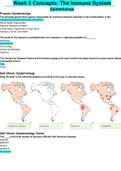
Week 5 Concepts: The Immune System Epidemiology Prepare: Epidemiology • The principal government agency responsible for tracking infectious diseases in the United States is the • The study of the frequency and distribution of a disease in a defined population is . • The Centers for Disease Control and Prevention assigns the most virulent microbes known to cause human disease to biosafety level 4. Self-Check: Epidemiology Drag the label to the following diagram according to the type of outbreak shown. Self-Check: Epidemiology Terms • The is the total number of persons afflicted with infectious disease. • A is an epidemic occurring over multiple continents. Reflect: Epidemiology • The prevalence rate of tuberculosis in one particular county in Texas is 7/1000 people, while the incidence rate for 2011 is 2/1000 people. Analyze this data and summarize the situation. • The number of new cases of a disease in a population over a specific period of time compared with the healthy population is the . • A disease that has a steady frequency over time in a particular geographic location is referred to as . • The study of the frequency and distribution of a disease in a defined population is . • The Centers for Disease Control and Prevention mandates that some diseases must be reported, while it is not necessary for others. This is so that • The total number of deaths in a population due to a disease is the rate. Innate Immune Function Prepare: Innate Immune Function • Which of the following DO NOT form part of physical barriers? • The immune defenses are divided into how many basic categories? • Chemical barriers include: (Select all that apply) • Monocytes differentiate into when the cells migrate to tissues. Self Check: Nonspecific Chemical Defenses • Nonspecific chemical defenses include: Self Check: Phagocytosis • Which of the following is not an event of phagocytosis? Self Check: Neutrophils, eosinophils, and basophils Self Check: White blood cells • Which of the white blood cells produces chemicals that can attack large helminths? Self Check: Interferon production • Host cells that produce interferon after viral attack can protect themselves from the invasion. Self Check: Membrane attack stage • The membrane attack stage of the complement cascade involves: Self Check: Inflammation • Which of the following is mismatched in relation to inflammation? Reflect: Innate Immune Function • The chemical found in tears and saliva that hydrolyzes the peptidoglycan in certain bacterial cell walls is: • The blood cells that function in allergic reactions and inflammation, contain peroxidase and lysozyme, and particularly target parasitic worms and fungi are: • The least numerous of all white blood cells that release histamine during inflammation and allergic reactions are: • The branch of the immune system present at birth is called: • The process in which the phagocytic cells move to the bacteria: • Match the following cells with their characteristics: • List the following steps of phagocytosis in order: Adaptive Immune Function Prepare: Adaptive Immune Function • A foreign molecule that causes a specific immune response is a(n): • Acquired specific immunity involves the response of: • Plasma cells: Self Check: Specific immunity • Specific immunity provides long-lasting protection through the production of: Self Check: Adaptive immune system • The cells of the adaptive immune system are educated to distinguish your cells from invading pathogens, cells that would respond to self-antigens are destroyed in immune tolerance. This property of adaptive immunity is attributed to the Self Check: T cells • T cells mature in the bone marrow? Self Check: Properties of effective antigens Properties of effective antigens include all of the following except: Self Check: Humoral immunity • T helper cells play a pivotal role in Self Check: MHC-II antigen Self Check: Antigen presenting cells • Antigen presenting cells: Self Check: Killer T cells For a CD8 killer T cell (TC) to become activated, it must recognize a foreign peptide complexed with self MHC-I and mount a direct attack upon the target cell. Self Check: Lymphocytes • Which lymphocyte secretes antibodies in a specific immune response? Self Check: Antibodies Self Check: Antigen response • A patient was never exposed nor vaccinated against chickenpox. A couple days ago the patient was exposed, and the patient currently has chicken pox virus. Which antibody would you expect to have the highest titer based on this exposure? • Two months later, the same patient is then exposed to chicken pox virus again. Which immunoglobulin will be present in the highest amount after this new exposure? Self Check: Artificial active immunity • An example of artificial active immunity would be vaccination. Reflect: Adaptive Immune Function • The antibody-secreting progeny cells of a B-cell clone are called: • MHC molecules are found on all cells except: • Small foreign molecules that are too small by themselves to elicit an immune response are termed: • The immunoglobulin class that has a dimer form found in mucus, saliva, colostrum, and other body secretions is: • The immunoglobulin class that is the only one capable of crossing the placenta is: • Generates many B cells and T cells that are activated against specific antigens: • Cytotoxic T cells: • Specific immunity provides long-lasting protection through the production of: • Match the following to their description: • Match the following: • Which of the following would be affected when T helper cells are destroyed in HIV infections? Select all that apply.
Written for
- Institution
- Chamberlain College Nursing
- Course
- BIOS 242
Document information
- Uploaded on
- February 20, 2023
- Number of pages
- 9
- Written in
- 2022/2023
- Type
- OTHER
- Person
- Unknown
Subjects
-
bios 242 week 5 concepts the immune system

Document also available in package deal