WGU Data Driven Decision Making - C207- Latest 2023 Q&A
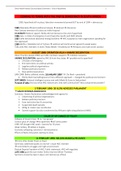
Activities (RBM stage) - Answer second step involves the process that converts inputs to outputs (actions necessary to produces results - training, evaluating, developing) Alternative hypothesis - Answer The argument that either a sample is not equal to, greater than, or less than the hypothesized null sample Analysis of Variance (ANOVA) - Answer a technique used to determine if there is a sufficient evidence from sample data of three or more populations to conclude that the means of the population are not all equal Analytics - Answer The discovery, analysis, and communication of meaningful patterns in data. Autocorrelation - Answer A relationship between two variables that is inherently non-linear Balanced Scorecard - Answer An approach using multiple measures to evaluate performance, including financial measures, and the non-financial measures of customers, internal business processes, and learning and growth. Bar chart - Answer A graph that measures the distribution of data over discrete groups or categories. Benchmarks - Answer Standards or points of reference for an industry or sector that can be used for comparison and evaluation. Big Data - Answer very large amounts of data; an all-encompassing term for any collection of data sets so large and complex that it becomes difficult to process them using traditional data processing applications Blind Study - Answer A study performed where the participants are not told if they are in the treatment group or control group body mass index (BMI) - Answer A measure, based on a person's weight and height, that is used to classify people as underweight or overweight. Business process - Answer A sequence of logically related and time based work activities to provide a specific output for a customer. Central Limit Theorem - Answer A theorem that states that, the greater the sample, the closer the mean of the sample is to the entire population and the more the results will look like a normal distribution Cluster Analysis - Answer The process of arranging terms or values based on different variables into "natural" groups Cointegration - Answer Occurs when two time series are moving with a common pattern due to a connection between the two time series Combination - Answer The number of different unordered possibilities for a certain situation. Complement - Answer The occurrence of an event not happening, the opposite Confidence interval - Answer An interval estimate used to indicate reliability Continuous Data - Answer Data that can lay along any point in a range of data Control chart - Answer A graphic display of process data over time and against established control limits, and that has a centerline that assists in detecting a trend of plotted values toward either control limit. Control limits - Answer The area composed of three standard deviations on either side of the centerline, or mean, of a normal distribution of data plotted on a control chart that reflects the expected variation in the data Criterion-reference test - Answer compare an individual to certain defined standards Critical Success Factors - Answer The important things an entity must do to be successful, such as quality measures, customer service, or efficiency. Cumulative Average-Time Learning Model - Answer A learning curve model in which the cumulative average time per unit declines by a constant percentage each time the cumulative quantity of units produced is doubled Cumulative distributions - Answer The probability that a random variable will be found at a value less than or equal to a given number Customer satisfaction - Answer A measure of the extent to which customers are satisfied with the products and related services they received from a supplier. Cycle time - Answer The total elapsed time to move a unit of work from the beginning to the end of a physical process, as defined by the producer and the customer. Cyclicality - Answer Repetition of up (peaks) or down movements (troughs) that follow or counteract a business cycle that can last several years Data Management - Answer The management, including cleaning and storage, of collected data. Data Mining - Answer the process of discovering patterns in large data sets; performed on big data to decipher patterns from these large databases Data Set - Answer A collection of related data records on a storage device. Davenport Kim Three Stage Model - Answer A decision making model developed by Thomas Davenport and Jinho Kim that consists of three stages: framing the problem, solving the problem, and communicating results Dependent Variable - Answer The variable whose value depends on one or more variables in the equation; typically the cost or activity to be predicted Detractor - Answer A category of customer used in the calculation of the Net Promoter Score that indicates an unhappy customer. Discrete Data - Answer Data that can only take on whole values and has clear boundaries Double Blind Study - Answer A study performed where neither the treatment allocator nor the participant knows which group the participant is in Economic Value Added (EVA) - Answer Net income (after taxes) earned in excess of the amount of net income required to earn the company's cost of capital. Epidemiology - Answer study of the incidence, distribution and possible control of diseases and other factors relating to health Event - Answer An outcome that occurs Experience Curve - Answer A curve that shows the decline in cost per unit in various business functions of the value chain as the amount of these activities increases Heteroscedasticity - Answer A regression in which the variances in y for the values of x are not equal Histogram - Answer A graph that displays continuous data. This type of graph has vertical bars that show the counts or numbers in each range of data. Homoscedasticity - Answer A regression in which the variances in y for the values of x are equal or close to equal Hypothesis - Answer A proposed explanation used as a starting point for future examination Impact (RBM stage) - Answer last step when applying results-based management is to study the long-term effects that the output will have (economic, environmental, cultural, or political change) Incidence - Answer measures the number of new cases that arise in a population over the course of a designated time period Incremental Unit-Time Learning Model - Answer A learning curve model in which the incremental unit time (the time needed to produce the last unit) declines by a constant percentage each time the cumulative quantity of units produced is doubled Independent Variable - Answer The variable presumed to influence another variable (dependent variable); typically it is the level of activity or cost driver Information Bias - Answer A prejudice in the data that results when either the respondent or the interviewer has an agenda and is not presenting impartial questions or responding with truly honest responses, respectively Input (RBM stage) - Answer the first step of RBM is to define the resources, human or financial, used by the RBM system (people, funds, information) Interquartile range - Answer The difference, in value, between the bottom and top 25 percent of the sample or population Interval Data - Answer Data that is ordered within a range and with each data point being an equal interval apart Irregularity - Answer One-time deviations from expectations caused by unforeseen circumstances such as war, natural disasters, poor weather, labor strikes, single-occurrence company- specific surprises or macroeconomic shocks Item Response Theory (IRT) - Answer model of designing, analyzing and scoring tests Key Performance Indicator (KPI) - Answer A performance measurement that organizations use to quantify their level of success. Laspeyres Index - Answer a comparison of the same quantity of goods with the same weight over a period of time Line graph - Answer A graph that illustrates relationships between two changing variables with a line or curve that connects a series of successive data points Lower limit control - Answer The minimum value on a control chart that a process should not exceed Mean - Answer An average, calculated by adding a series of elements in a data set together and dividing by the total number in the series Measurement Bias - Answer A prejudice in the data that results when the sample is not representative of the population being tested Median - Answer The value or quantity lying at the midpoint of a frequency distribution Multicollinearity - Answer A multiple regression equation is flawed because two variables thought to be independent are actually correlated to be independent Multiple Linear Regression - Answer A statistical method used to model the relationship between one dependent (or response) variable and two or more independent (or explanatory) variables by fitting a linear equation to observed data Multiplication Principle - Answer When the probabilities of multiple events are multiplied together to determine the likelihood of all of those events occurring Mutually exclusive events - Answer When two or more events are not able to occur at the same time
Written for
- Institution
- Western Governers University
- Course
- C207
Document information
- Uploaded on
- April 21, 2023
- Number of pages
- 12
- Written in
- 2022/2023
- Type
- Exam (elaborations)
- Contains
- Questions & answers
Subjects
-
wgu c207
-
c207
-
wgu data driven decision making c207
-
activities rbm stage answer second step involves the process that converts inputs to outputs actions necessary to produces results training

Document also available in package deal