MECH 344 Problem Set 6-Chapter 12_Helical Compression
Spring-Selected Problems Concordia University
SOLUTION (12.21)
Known: A machine uses a pair of concentric helical compression springs to support a
known static load. Both springs are made of steel and have the same length when
loaded and when unloaded.
Find: Calculate the deflection and the maximum stress in each spring.
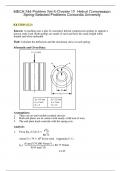
Schematic and Given Data:
F = 3.0 kN
do di
Di
Do
Do = 45 mm Di = 25 mm
do = 8 mm di = 5 mm
No = 5 Ni = 10
Assumptions:
1. There are no unfavorable residual stresses.
2. Both end plates are in contact with nearly a full turn of wire.
3. The end plate loads coincide with the spring axis.
Analysis:
4
d G
1. From Eq. (12.8), k = 3
8D N
where G = 79 ✕ 109 Pa for steel. (Appendix C-1)
(8 mm)4(79, 000 N/mm2)
ko = = 88. 77 N/mm
8(45 mm)3(5)
12-25
, (5 mm)4(79, 000 N/mm2)
ki = = 39. 50 N/mm
8(25 mm)3(10)
12-26
, F or = F
2. From Eq. (12.8), k =
k
3, 000
= = 23. 39 mm
(39. 5 + 88. 77) ■
3. Using F = k, we can calculate the force on each spring.
Fo = ko = (88.77 N/mm)(23.39 mm) = 2076 N
Fi = ki = (39.50 N/mm)(23.39 mm) = 924 N
4. Using Fig. 12.4, we can find Ks values for each spring.
For outer spring, C = 45/8 = 5.63, Ks = 1.09
For inner spring, C = 25/5 = 5.00, Ks = 1.10
5. From Eq. (12.6), = 8FD Ks
d
8(2076)(45)
o = (1. 09) = 506 MPa ■
(8)
8(924)(25)
i = (1. 10) = 518 MPa ■
(5)
SOLUTION (12.22)
Known: A machine uses a pair of concentric helical compression springs to support a
known static load. Both springs are made of steel and have the same length when
loaded and when unloaded.
Find: Calculate the deflection and the maximum stress in each spring.
Schematic and Given Data:
F = 3.0 kN
do di
Di
Do
Do = 50 mm Di = 30 mm
do = 9 mm di = 5 mm
No = 5 Ni = 10
12-27
Spring-Selected Problems Concordia University
SOLUTION (12.21)
Known: A machine uses a pair of concentric helical compression springs to support a
known static load. Both springs are made of steel and have the same length when
loaded and when unloaded.
Find: Calculate the deflection and the maximum stress in each spring.
Schematic and Given Data:
F = 3.0 kN
do di
Di
Do
Do = 45 mm Di = 25 mm
do = 8 mm di = 5 mm
No = 5 Ni = 10
Assumptions:
1. There are no unfavorable residual stresses.
2. Both end plates are in contact with nearly a full turn of wire.
3. The end plate loads coincide with the spring axis.
Analysis:
4
d G
1. From Eq. (12.8), k = 3
8D N
where G = 79 ✕ 109 Pa for steel. (Appendix C-1)
(8 mm)4(79, 000 N/mm2)
ko = = 88. 77 N/mm
8(45 mm)3(5)
12-25
, (5 mm)4(79, 000 N/mm2)
ki = = 39. 50 N/mm
8(25 mm)3(10)
12-26
, F or = F
2. From Eq. (12.8), k =
k
3, 000
= = 23. 39 mm
(39. 5 + 88. 77) ■
3. Using F = k, we can calculate the force on each spring.
Fo = ko = (88.77 N/mm)(23.39 mm) = 2076 N
Fi = ki = (39.50 N/mm)(23.39 mm) = 924 N
4. Using Fig. 12.4, we can find Ks values for each spring.
For outer spring, C = 45/8 = 5.63, Ks = 1.09
For inner spring, C = 25/5 = 5.00, Ks = 1.10
5. From Eq. (12.6), = 8FD Ks
d
8(2076)(45)
o = (1. 09) = 506 MPa ■
(8)
8(924)(25)
i = (1. 10) = 518 MPa ■
(5)
SOLUTION (12.22)
Known: A machine uses a pair of concentric helical compression springs to support a
known static load. Both springs are made of steel and have the same length when
loaded and when unloaded.
Find: Calculate the deflection and the maximum stress in each spring.
Schematic and Given Data:
F = 3.0 kN
do di
Di
Do
Do = 50 mm Di = 30 mm
do = 9 mm di = 5 mm
No = 5 Ni = 10
12-27