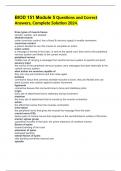
BIOD 151 Module 5 Questions and Correct Answers, Complete Solution 2024.
BIOD 151 Module 5 Questions and Correct Answers, Complete Solution 2024. three types of muscle tissue smooth, cardiac, and skeletal skeletal muscle under conscious control; has a blood & nervous supply to enable movement conscious control a person decided to use this muscle to complete an action motor action a message is formed in the brain, is sent to the spinal cord, then sent to the peripheral nervous system and finally to the correct muscle peripheral nerves middle man of carrying a message from central nervous system to specific end point sensory input the nerves of the peripheral nervous system carry messages that start externally to the central nervous system what action are muscles capable of they can only pull (contract) and then relax again tendons connective tissue that connects skeletal muscles to bone, they are flexible and can bend at joints and cushion against sudden movement ligaments connective tissues that connects bone to bone and stabilizes joints origin bony site of attachment that is stationary during movement insertion the bony site of attachment that is moved by the muscle contraction action the effect that comes from the muscles contraction innervation the peripheral nerve that gives the muscle the message from the brain cranial nerve (CN) twelve pairs of cranial nerves that originate on the ventral/anterior surface of the brain erector spinae group superficial muscles in the back; the prime extensors of vertebral column flexion of spine forward bending of the trunk extension of spine backward bending lateral flexion of spine side bending movement around axis spinalis medial column of erector spinae; three divisions: spinalis thoracis, spinalis cervicis, spinalis capitis longissimus intermediate column of erector spinae; three divisions: longissimus thoracis, longissimus cervicis, longissimus capitis) Iliocostalis lateral column of erector spinae; three divisions: iliocostatlis lumborum, iliocostalis thoracis, iliocostalis cervicis) abdominal muscles help with supporting and protecting the abdominal viscera which are not protected by bone structures & they help to provide support for upright posture & balance posterior thorax back of thoracic cage trapezius the most superficial muscle of the back retraction movement of a structure in the posterior direction protraction movement in the anterior direction elevation upward movement of a body part depression downward movement of a body part why does the shoulder require so many ligaments to stabilize it? the glenoid cavity of the scapula is very small in comparison to the head of the humerus why is the rotator cuff so important it is extremely vital to the stabilization of the shoulder joint hip extension moving the thigh posteriorly hip flexion moving the thigh anteriorly knee extension straighten the knee/ increase the angle of the joint knee flexion bending the knee / decreasing the angle of the joint lateral rotation rotation away for the center of the body internal rotation (medial rotation) towards the central axis of the body Iliopsoas group psoas major and iliacus thigh movements refer to movements of the femur muscles are capable of having multiple actions and are able to act on multiple joints involuntary control
Written for
- Institution
- BIOD 151
- Course
- BIOD 151
Document information
- Uploaded on
- February 19, 2024
- Number of pages
- 5
- Written in
- 2023/2024
- Type
- Exam (elaborations)
- Contains
- Questions & answers
Subjects
-
biod 151 module 5 questions and correct answers c

Document also available in package deal