ACSM Exercise Physiologist Exam Questions and Answers with complete solution
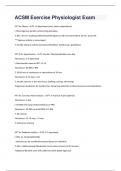
FITT for Obese - F: ≥5 days/week (max. caloric expenditure) I: Mod-Vigorous Aerobic activity (Vig-desirable) T: Min. 30 min -totaling ≥150min/week (Progress to 60 min) intermittent 10 min. bouts OK **Vigorous activity is encouraged T: Aerobic physical activity (resistance/flexibility -healthy pop. guidelines) FITT-P for Hypertensive - F: Aerobic: Most/preferably every day Resistance: 2-3 days/week I: Mod-aerobic exercise RPE: 11-13 Resistance: 60-80% 1-RM T: 30-60 min of continuous or intermittent of 10 min. Resistance: 8-12 reps; 1 set T: Aerobic exercise is the main focus (walking, cycling, swimming) Progression:Guidelines for healthy Pop. Except pay attention to blood pressure and medications FITT for Coronary Heart Disease - F: 3-4 d/w (5-6 d/w Optimal) Resistance: 2 d/w I: 50-60% (75) symp-limited VO2max or HRR Resistance: 30-50% up to 60-80% of 1-RM T: 30 minutes Resistance: 12-15 reps, 1-3 sets T: Endurance training FITT for Diabetes mellitus - F: 3-7 days/week I: RPE: 11-13 (40-60%VO2R) -Intensity can be modified/increased based on individual T: Min: ≥150min/week (Moderate) Can be done in bouts of 10 minutes Additional Benefits seen with ≥300 min/week (Mod-Vigorous)T: Emphasis activities using large muscle groups -Rhythmic & continuous exercise Progression: Increase exercise Duration first. Then increase Intensity. Resistance Training is also beneficial in absence of contraindication FITT for Osteoarthritis - F: Aerobic: 3-5 days/week Resistance: 2-3d/w Flexibility (ROM) I: Low-moderate T: ≥150min/week or 10 min bouts as tolerated T: Aerobic Exercise -low impact Progression: Should be gradual and tailored individually as tolerated FITT for Cancer - F: Aerobic: 3-5 days/week Resistance: 2-3 d/w Flexibility: Can be done daily (even during treatment) I: Highly Variable during treatment; RPE; Slow Progression T: Aerobic:Short bouts several times/day during treatment Survivors without exacerbation can follow healthy population guidelines Resistance: 8-12 reps; 1 set T: Aerobic -prolonged (walking, cycling swimming) Progression: Slow; Avoid fatigue FITT for Dysplidemia - ≥5days/week (maximize caloric expenditure) I: 40-75%VO2R T: 30-60 min 50-60 min -to promote weight loss Can be done in bouts of 10 minutes if necessary T: Aerobic Activities Resistance/flexibility guidelines for healthy pop. can be followed in absence of contraindicationsFIbromyalgia - F: 2-3 days/week (Progress to: 3-4d/w) Resistance: 2-3d/w Flexibility: 1-3 d/w I: 30% VO2R or HRR (Progress to: 60%) Resistance: 50-80% of 1-RM (Decrease if pain is present) Flexibility: Active gentle ROM T: 10 min increments totaling 30 min (Progress to: 60 min) Resistance: Strength -3-5 reps; 2-3 sets Endurance-10-20 reps; 2-3 sets Flexibility: Hold stretch 10-30 sec (progress to 60 sec) T: Low-impact/non-weight bearing activities (Water exercise, walking, cycling) Resistance: Elastic bands, cuffs/ankle weights, weight machines Flexibility: Elastic bands, non-weight-bearing FITT for Asthma - F: 2-3 days/week I: Aprox. At the lactate threshold (anaerobic threshold) T: 20-30 min/day T: Aerobic activity (Avoid chlorinated pools) Resistance/flexibility FITT for COPD - F: Aerobic: 3-5 days/week I: Light and Vigorous (as tolerated-but encouraged) T: Only a few min. may be tolerated; Interval training is successful with rest periods T: Walking and/or cycling Arteriosclerosis - Hardening of arteries
Written for
- Institution
- ACSM Exercise Physiologist
- Course
- ACSM Exercise Physiologist
Document information
- Uploaded on
- February 23, 2024
- Number of pages
- 13
- Written in
- 2023/2024
- Type
- Exam (elaborations)
- Contains
- Questions & answers
Subjects
-
acsm

Document also available in package deal