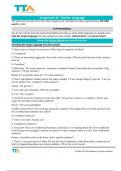
Assignment B – Teacher Language
This document should not be more than 3 pages long, including this page; approximately 700-1000
words in total.
a) Presentation
You do not need to show the entire presentation but show us some of the language you would use to
elicit the target language from the context you have chosen, elicit the form, and concept check.
Show the Actual Words you would use for:
i) Eliciting the Target Language from the Context
T: (Referring to examples from warmer) What type of sentences are these?
S: Compound?
T: That’s an interesting suggestion. Now look at this example. What does the first part of the sentence
refer to?
S: Condition?
T: Well done, ‘If it rains tomorrow’ expresses a condition! Daniel, what about the second part of the
sentence: ‘I’ll stay at home’?
Daniel: It’s a possible action for ‘if it rains tomorrow.’
T: That’s right Daniel. Aitana, look at this other example ‘I’ll use Google Maps if I get lost.’ Can you
tell me which is the ‘condition’ in this sentence?
Aitana: ‘If I get lost’?
T: Let’s ask your classmates. What do you think?
Ss: Yes. Yes, we agree.
T: Good job everyone! Aitana you were also right, ‘If I get lost’ refers to a ‘condition’. Oliver, and
what’s the possible result of that condition?
Oliver: ‘I’ll use Google Maps’
Teacher: Great Oliver! You are doing a great job, students. Now going back to our first question, how
do you think these sentences are called?
S: Condition sentences?
T: That’s very near! Anyone else?
S: Conditional sentences?
T: Great job! These are Conditional Sentences, and today we’re learning about the First Conditional.
From the previous examples, what do you think we want to express when we use a First Conditional
sentence?
Emma: A possible action in the future with a special condition?
T: That’s a very good answer Emma. We use the First Conditional to talk about future events that are
likely to happen depending on a certain condition. (Write this on the board)
© 2022 The TEFL Academy. All rights reserved.
This document should not be more than 3 pages long, including this page; approximately 700-1000
words in total.
a) Presentation
You do not need to show the entire presentation but show us some of the language you would use to
elicit the target language from the context you have chosen, elicit the form, and concept check.
Show the Actual Words you would use for:
i) Eliciting the Target Language from the Context
T: (Referring to examples from warmer) What type of sentences are these?
S: Compound?
T: That’s an interesting suggestion. Now look at this example. What does the first part of the sentence
refer to?
S: Condition?
T: Well done, ‘If it rains tomorrow’ expresses a condition! Daniel, what about the second part of the
sentence: ‘I’ll stay at home’?
Daniel: It’s a possible action for ‘if it rains tomorrow.’
T: That’s right Daniel. Aitana, look at this other example ‘I’ll use Google Maps if I get lost.’ Can you
tell me which is the ‘condition’ in this sentence?
Aitana: ‘If I get lost’?
T: Let’s ask your classmates. What do you think?
Ss: Yes. Yes, we agree.
T: Good job everyone! Aitana you were also right, ‘If I get lost’ refers to a ‘condition’. Oliver, and
what’s the possible result of that condition?
Oliver: ‘I’ll use Google Maps’
Teacher: Great Oliver! You are doing a great job, students. Now going back to our first question, how
do you think these sentences are called?
S: Condition sentences?
T: That’s very near! Anyone else?
S: Conditional sentences?
T: Great job! These are Conditional Sentences, and today we’re learning about the First Conditional.
From the previous examples, what do you think we want to express when we use a First Conditional
sentence?
Emma: A possible action in the future with a special condition?
T: That’s a very good answer Emma. We use the First Conditional to talk about future events that are
likely to happen depending on a certain condition. (Write this on the board)
© 2022 The TEFL Academy. All rights reserved.