20.3 Force on a Moving Charge
Observing the Force on a Moving Charge
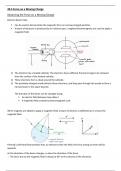
Electron Beam Tube:
▪ Can be used to demonstrate the magnetic force on moving charged particles.
▪ A beam of electrons is produced by an ‘electron gun’, magnets/electromagnets are used to apply a
magnetic field.
1) The electron has a heated cathode. The electrons have sufficient thermal energy to be released
from the surface of the heated cathode.
2) These electrons form a cloud around the cathode.
3) The positively-charged anode attracts these electrons, and they pass through the anode to form a
narrow beam in the space beyond.
The direction of the beam can be changed using:
▪ An electric field between two plates /
▪ A magnetic field created by electromagnetic coils
When magnets are added to apply a magnetic field, a beam of electron is deflected as it crosses the
magnetic field.
Fleming’s Left Hand Rule predicts that, as electrons enter the field, the force acting on them will be
upwards.
As the direction of the beam changes, so does the direction of the force.
The force due to the magnetic field is always at 90o to the velocity of the electrons.
, It is this force acting on individual electrons that gives rise to the motor effect that can be witnessed on
the macroscopic scale on current-conducting wires. The electrons in a wire experience a force when they
flow across a magnetic field. They transfer the force to the wire itself.
Magnetic Force on a Moving Charged Particle
A charged particle is moving in a region of uniform magnetic field, with its velocity at right angles to the
field.
Factors that determine the size of the force on the particle:
1) The magnetic flux density, B
2) The charge on the particle, q
3) The speed of the particle, v
The magnetic force on a moving particle at right angles to a magnetic field
𝐹 = 𝐵𝑞𝑣
The direction of the force can be determined from Fleming’s Left Hand Rule.
The force is always at 90o to the velocity of the
particle. Consequently, the path described by
the particle will be a circular path.
Observing the Force on a Moving Charge
Electron Beam Tube:
▪ Can be used to demonstrate the magnetic force on moving charged particles.
▪ A beam of electrons is produced by an ‘electron gun’, magnets/electromagnets are used to apply a
magnetic field.
1) The electron has a heated cathode. The electrons have sufficient thermal energy to be released
from the surface of the heated cathode.
2) These electrons form a cloud around the cathode.
3) The positively-charged anode attracts these electrons, and they pass through the anode to form a
narrow beam in the space beyond.
The direction of the beam can be changed using:
▪ An electric field between two plates /
▪ A magnetic field created by electromagnetic coils
When magnets are added to apply a magnetic field, a beam of electron is deflected as it crosses the
magnetic field.
Fleming’s Left Hand Rule predicts that, as electrons enter the field, the force acting on them will be
upwards.
As the direction of the beam changes, so does the direction of the force.
The force due to the magnetic field is always at 90o to the velocity of the electrons.
, It is this force acting on individual electrons that gives rise to the motor effect that can be witnessed on
the macroscopic scale on current-conducting wires. The electrons in a wire experience a force when they
flow across a magnetic field. They transfer the force to the wire itself.
Magnetic Force on a Moving Charged Particle
A charged particle is moving in a region of uniform magnetic field, with its velocity at right angles to the
field.
Factors that determine the size of the force on the particle:
1) The magnetic flux density, B
2) The charge on the particle, q
3) The speed of the particle, v
The magnetic force on a moving particle at right angles to a magnetic field
𝐹 = 𝐵𝑞𝑣
The direction of the force can be determined from Fleming’s Left Hand Rule.
The force is always at 90o to the velocity of the
particle. Consequently, the path described by
the particle will be a circular path.