NURS 3100 Exam 1 || With complete solutions.
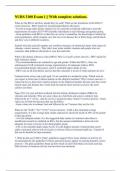
What are the RDA's and how should they be used? What are the limitations of the RDA's? correct answers - RDA stands for recommended dietary allowance. - It is the average daily dietary intake level of a nutrient considered sufficient to meet the requirements of nearly all (97-98%) healthy individuals in each lifestage and gender group. - Some problems with RDA's is that they are set by a committee, the knowledge is limited for some populations, safety margins vary (do not cover disease, Rx or illicit drugs, and alcohol), and they vary in different countries. Explain why hair and nail samples are worthless measures of nutritional status with respect to vitamins. correct answers - They don't store water soluble vitamins and people who use cosmetics adds different chemicals to your hair and nails. What is the dietary reference value (DRV)? How is it used? correct answers - DRV stands for daily reference values. - The recommendations are outlined by age and gender. Within the DRVs , there are subcategories EAR (estimated average requirements), AI (adequate intake), RDA (recommended dietary allowance), and UL (tolerable upper intake levels). - DRV's are on all food labels; used so that the consumer is aware of what nutrients are in it. Fraternal twins (a boy and a girl aged 17) are enrolled in a metabolic study. Which twin do you expect to burn more Calories/minute on the elliptical machine? Why? correct answers - I expect the boy to burn more calories/minute on the elliptical machine because men have more muscle mass and females have more body fat and the more muscle you have, the more calories you burn. Pages 582-3 in your nutrition textbook lists the Dietary Reference Intakes (DRIs) for vitamins and minerals. Why are some values in a bold font and some in ordinary type followed by an * ? (Um... and do not try to memorize these values!!!) correct answers - Some values are in bold font because they are the RDAs. - Some values are in ordinary font and followed by an * because they are the AIs. What are the "EAR," "AI," "UTL?" correct answers - EAR is the estimated average requirements. It is the average daily intake expected to satisfy the needs of 50% of the people in that age group. - AI is the adequate intake. It is the suggested daily intake of a nutrient when there is insufficient research to establish an RDA, but the amount established is believed to be adequate for most everyone in the demographic group. - UTL is the tolerable upper intake levels. It is the highest amount of nutrient that can be safely consumed with no risk of toxicity or adverse effects on human health (ex. Vitamin D that can be harmful in large amounts). 7. What do the new USDA "plate" guidelines suggest? How many minutes of activity are recommended by the guidelines? (These questions always appear on nursing boards!) correct answers - The plate guidelines break up how much of each food intake you need each day. Half an hour of strenuous activity and one hour non strenuous
Written for
- Institution
- NURS 3100
- Course
- NURS 3100
Document information
- Uploaded on
- May 29, 2024
- Number of pages
- 7
- Written in
- 2023/2024
- Type
- Exam (elaborations)
- Contains
- Questions & answers
Subjects
-
what are the rdas and how should they be used wh

Document also available in package deal