KNOWLEDGE AREA:
Life Process in Plants and
Animals.
TOPIC 5.4: Excretion
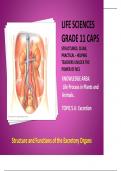
Structure and Functions of the Excretory Organs
, Introduction
Gut
Lungs
Skin
Liver
Kidneys
Structure of the Urinary System
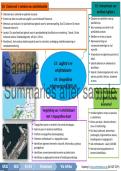
,Excretion is the removal of metabolic wastes from
the living organism.
Metabolic wastes are waste substances that are
produced during metabolic reactions.
Some examples of the metabolic wastes are urea, uric
acid and carbon dioxide.
These substances can be very dangerous if allowed to
accumulate in the body.
For example if carbon dioxide is allowed to collect in the
body it combines with water to form carbonic acid.
This would change the pH of the tissue fluid and affect
the functioning of enzymes.
, TERM:
Excretion
DEFINITION: USE IN SENTENCE:
Excretion is the removal of Carbon dioxide leaves the
metabolic waste from the body through excretion
body
Life Process in Plants and
Animals.
TOPIC 5.4: Excretion
Structure and Functions of the Excretory Organs
, Introduction
Gut
Lungs
Skin
Liver
Kidneys
Structure of the Urinary System
,Excretion is the removal of metabolic wastes from
the living organism.
Metabolic wastes are waste substances that are
produced during metabolic reactions.
Some examples of the metabolic wastes are urea, uric
acid and carbon dioxide.
These substances can be very dangerous if allowed to
accumulate in the body.
For example if carbon dioxide is allowed to collect in the
body it combines with water to form carbonic acid.
This would change the pH of the tissue fluid and affect
the functioning of enzymes.
, TERM:
Excretion
DEFINITION: USE IN SENTENCE:
Excretion is the removal of Carbon dioxide leaves the
metabolic waste from the body through excretion
body