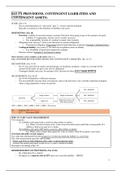
IAS 37: PROVISIONS, CONTINGENT LIABILITIES AND
CONTINGENT ASSETS:
SCOPE: (Par 1-9)
− Due to misinterpretation of “provisions” (par 7) – ensures uniform treatment
− Basically an extension of the definition of liabilities and assets
DEFINITIONS: (Par 10)
− Provision: Liability of uncertain timing or amount (Not know when going to pay or the amount to be paid)
o Liability: 4th requirement: Amount can be reliably measured
o E.g. responsibility in terms of a contract to repair, sales warranty
− Obligating event: See par 17 [Past event that leads to a present obligation]
o Constructive obligation: Expectation based on past behaviour or practise (Example 4: Refunds Policy)
− Contingent liability: (b)(i) and (ii): Not meet the recognition criteria of liability
o E.g. Possibility of legal action against the company
− Onerous contract: Example 8: An Onerous Contract
PROVISIONS AND OTHER LIABLITIES: (Par 11)
RELATIONSHIP BETWEEN PROVISIONS AND CONTINGUENT LIABILITIES: (Par 12-13)
RECOGNITION: (Par 14-35)
− Par 18: E.g. provision for repairs and maintenance of machinery and plant = relates to costs that will be
incurred in the future (no past event, thus no obligation)
− Contingent liability and asset: No amount in FSs, disclosed in Notes (unless remote [0-20%])
MEASUREMENT: (Par 36-52)
− Par 39-40: Probabilities of different estimates
− The most probable outcome when assessing the value of the provision is not a reliable estimation techniques
where a large population of items are present.
50% - R5000.00
Range of items Weigh all outcomes 30% - R4000.00
Outcomes
Weigh all outcomes OR
Single item 20% - R3000.00
Most likely outcome
50% x 5000 + 30% x 4000 + 20% x 3000 = Provision
Dt Expense (P/L) Before tax!
Ct Provision (SFP)
IFRS 13: FAIR VALUE MEASUREMENT
Two categories:
[1] Liabilities and equity held as assets by other entities or parties
E.g. Where A borrows money to B. A has a loan receivable (asset) and B has a loan payable. B’s
liability is held as an asset in A’s books.
[2] Liabilities and equity NOT held as assets by other entities or parties
E.g. Where A has a legal claim against B. A has no entries, while B recognizes a provision.
Provisions fall under second category
Fair value thus determined from the perspective of entity that holds the liability (i.e. provision)
Fair value measurement must take into account:
- Future cash flows to fulfil obligation (Fair value = expected present value)
- Amount that market participant would receive to enter in identical liability
Descriptive accounting (Chpt. 35)
REIMBURSEMENT OF PROVISIONS: (Par 53-58)
− By a third party (E.g. insurer)
− Recognise as a separate asset in SFP (may not exceed the liability) – GROSS
1
CONTINGENT ASSETS:
SCOPE: (Par 1-9)
− Due to misinterpretation of “provisions” (par 7) – ensures uniform treatment
− Basically an extension of the definition of liabilities and assets
DEFINITIONS: (Par 10)
− Provision: Liability of uncertain timing or amount (Not know when going to pay or the amount to be paid)
o Liability: 4th requirement: Amount can be reliably measured
o E.g. responsibility in terms of a contract to repair, sales warranty
− Obligating event: See par 17 [Past event that leads to a present obligation]
o Constructive obligation: Expectation based on past behaviour or practise (Example 4: Refunds Policy)
− Contingent liability: (b)(i) and (ii): Not meet the recognition criteria of liability
o E.g. Possibility of legal action against the company
− Onerous contract: Example 8: An Onerous Contract
PROVISIONS AND OTHER LIABLITIES: (Par 11)
RELATIONSHIP BETWEEN PROVISIONS AND CONTINGUENT LIABILITIES: (Par 12-13)
RECOGNITION: (Par 14-35)
− Par 18: E.g. provision for repairs and maintenance of machinery and plant = relates to costs that will be
incurred in the future (no past event, thus no obligation)
− Contingent liability and asset: No amount in FSs, disclosed in Notes (unless remote [0-20%])
MEASUREMENT: (Par 36-52)
− Par 39-40: Probabilities of different estimates
− The most probable outcome when assessing the value of the provision is not a reliable estimation techniques
where a large population of items are present.
50% - R5000.00
Range of items Weigh all outcomes 30% - R4000.00
Outcomes
Weigh all outcomes OR
Single item 20% - R3000.00
Most likely outcome
50% x 5000 + 30% x 4000 + 20% x 3000 = Provision
Dt Expense (P/L) Before tax!
Ct Provision (SFP)
IFRS 13: FAIR VALUE MEASUREMENT
Two categories:
[1] Liabilities and equity held as assets by other entities or parties
E.g. Where A borrows money to B. A has a loan receivable (asset) and B has a loan payable. B’s
liability is held as an asset in A’s books.
[2] Liabilities and equity NOT held as assets by other entities or parties
E.g. Where A has a legal claim against B. A has no entries, while B recognizes a provision.
Provisions fall under second category
Fair value thus determined from the perspective of entity that holds the liability (i.e. provision)
Fair value measurement must take into account:
- Future cash flows to fulfil obligation (Fair value = expected present value)
- Amount that market participant would receive to enter in identical liability
Descriptive accounting (Chpt. 35)
REIMBURSEMENT OF PROVISIONS: (Par 53-58)
− By a third party (E.g. insurer)
− Recognise as a separate asset in SFP (may not exceed the liability) – GROSS
1